Parivarik ManuRanjan (2026): Pankaj Tripathi Anchors A Mansion Of Missed Opportunities

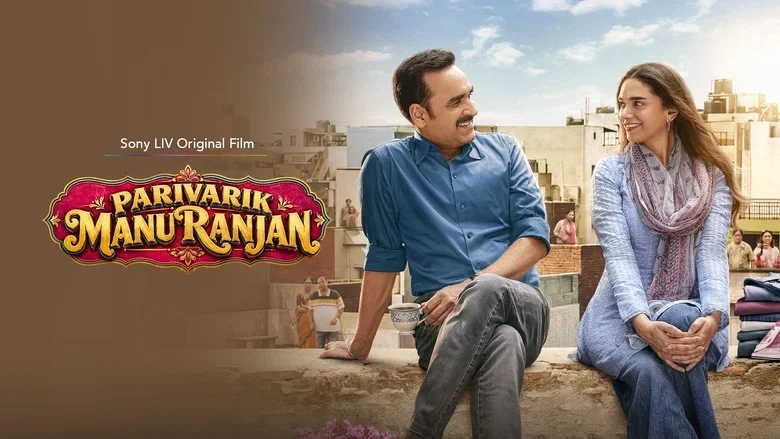
Pankaj Tripathi walks through a Lucknow haveli whose corridors outnumber its residents. The silence has a sound, and it is the sound of a premise that never quite decides what to do with itself.
A Bachelor, A Mansion, And A Premise That Whispers Instead Of Roars
Ranjan Dubey is forty, unmarried, and content in a way that the screenplay mistakes for dramatic tension. He occupies an ancestral mansion alone, and the film opens on the quiet rhythms of a man who has mistaken routine for peace.
The first real dramatic beat is a matchmaking attempt that collapses before it begins. It is a familiar comic setup, and Varun V. Sharma directs it with a light hand that never quite presses hard enough to draw blood.
Then Helen arrives. Aditi Rao Hydari enters as a Delhi property manager who discovers the mansion’s sole occupant is not a family but a single man. The employer-employee architecture is immediately the film’s most interesting and most unexamined idea.
When Forced Proximity Becomes A Structural Crutch
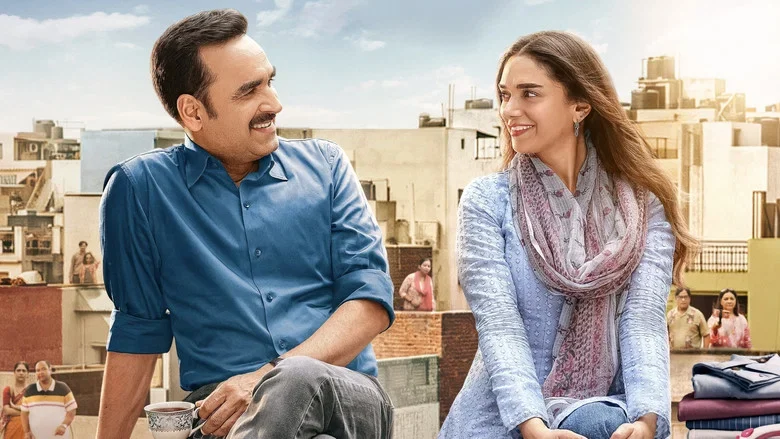
The romantic-comedy engine here runs on domestic proximity. Helen manages the house, Ranjan settles into being managed, and the film asks us to watch the slow erosion of his solitude.
What the screenplay resists is escalation. The conflict is social prejudice and marriage pressure, forces that the film treats as ambient weather rather than opposing army.
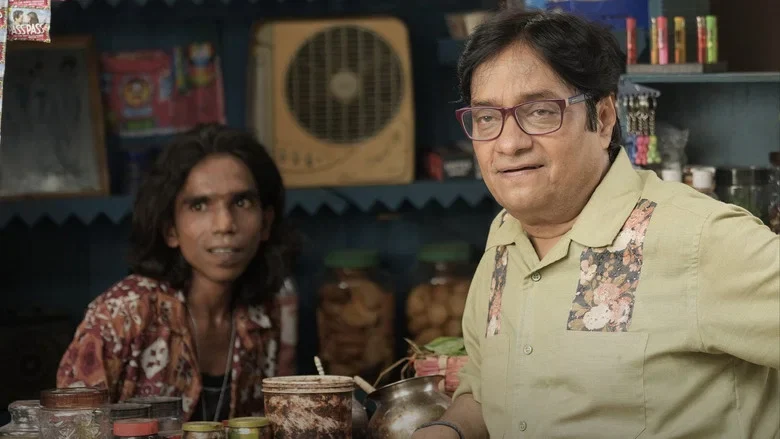
Brijendra Kala, who also co-wrote the screenplay with Sharma and Ali Abbas Zafar, plays the well-wisher who bridges Ranjan’s private routine and the surrounding community. His presence is warm but dramatically diffuse, a friend who exists to nudge rather than to challenge.
The film’s structural risk is clear: an employer-employee romance must credibly evolve into mutual desire while addressing the power imbalance baked into the arrangement. Sharma’s screenplay gestures at this without ever forcing the question.
That refusal to press is where the film’s banality, noted by more than one early viewer, takes root. The premise is not the problem. The problem is that the premise is never given an adversary worth the name.
Pankaj Tripathi’s Quiet Register And The Weight It Carries
Tripathi is the film’s gravitational center, and he plays Ranjan with a low-key stillness that recalls the contained menace he brought to his crime-lord turn in Mirzapur, inverted into domestic gentleness.
Watch how he occupies a room. He does not fill it. He sits in the middle distance, hands folded, eyes tracking Helen’s movements with the wariness of a man who has forgotten how to share space.
His comic timing is physical and minimal: a pause before answering, a slight lean away from a conversation he did not initiate, a face that registers social pressure as mild inconvenience. It is a performance of absence, and it works.
Hydari’s Helen is the film’s other anchor, and she plays the professional outsider with a spine the screenplay underuses. Her character’s independence is established in her arrival, then largely subordinated to the romance’s needs.
The pairing is the film’s chief commercial asset. Whether it is a dramatic one depends on how much you value chemistry over conflict.
Lucknow Light, Domestic Stillness, And A Score That Never Cuts
The ancestral mansion is the film’s most expressive element. Its scale dwarfs Ranjan, and Sharma’s camera understands that a man alone in an inherited house is a visual thesis about isolation and expectation.
What the film lacks is audiovisual pressure. Scenes unfold in flat, even light, and the score rarely intervenes to sharpen a moment’s edge. The result is a film that feels observed rather than driven.
Editing in the first half respects the slow rhythms of domestic introduction. By the second half, the story must shift toward social conflict, and the escalation feels softer than the premise demands.
This patient, character-led approach is a recognizable mode in contemporary Hindi comedies, and it can work when the writing supplies friction. Here, the friction is mostly ambient.
The Social Prejudice That Never Becomes A Villain
The film’s stated antagonist is social judgment: the expectation that a forty-year-old man should marry, and the discomfort that greets a relationship across class and employment lines.
That is a legitimate dramatic target. But prejudice only works as an antagonist when it has a face, a voice, a scene where it draws blood. This screenplay keeps it offstage.
The result is a romance that must generate its own stakes from domestic interaction alone. The employer-employee structure, which could have been the film’s sharpest source of tension, is softened into a meet-cute with a paycheck.
Where a sharper film might have forced Ranjan and Helen to confront what their arrangement means, this one lets the question dissolve into warmth. The warmth is genuine. The confrontation is not.
Bhanushali Productions, AAZ Films, And The OTT Bet
The film arrives on Sony LIV rather than in theaters, a distribution choice that shapes how we should read its commercial stakes. Bhanushali Productions and Ali Abbas Zafar’s AAZ Films are betting on the streaming family-entertainer lane.
That lane is crowded. Star-driven OTT romances live or die on subscriber pull, and Tripathi’s theatrical leverage does not automatically translate to a platform’s completion-rate metrics.
The direct-to-streaming model also removes the box-office scoreboard that would ordinarily settle arguments about a film like this. No opening-day figure will tell us whether the pairing worked. Only viewership data, which platforms rarely share, will decide.
For a producing banner, that is a safer bet than a theatrical gamble on a contained, low-conflict romance. For the audience, it means a film that never had to earn its escalation in a crowded theater.
The comparison to a theatrical release like Alexander Skarsgård's Wicker is instructive: theatrical films must fight for attention in a room full of distractions, while streaming romances can coast on goodwill and star familiarity.
A Romance That Chooses Comfort Over Consequence
The film’s resolution, whatever its exact shape, points toward companionship and family acceptance over social resistance. That is a warm ending, and warmth is not nothing.
But it is a resolution that arrives without the argument it needed. Ranjan and Helen’s bond is tested by judgment, and the film’s answer is that judgment can be outlasted by decency. That may be true. It is not dramatically sufficient.
The thematic sibling here is the kind of contemporary Hindi romantic comedy that mistakes likability for stakes, and Pehla Pyaar Doosri Baar shows how quickly that engine can run out of fuel when the writing coasts on charm.
Parivarik ManuRanjan has a better lead performance than most films in its lane. What it lacks is the courage to let its central relationship hurt before it heals.
Tripathi sits in that haveli, hands folded, waiting for a film that never quite arrives to challenge him. The mansion is vast. The movie is smaller than the house.

Ankit Jaiswal is the Chief Author, covering Indian cinema and OTT releases with honest, no-filler criticism. An SEO strategist by background, he brings a research-driven approach to film writing, cutting through hype to tell you exactly what's worth your time.
Related Movies & Releases