Blind Game (2026): Arjun Rampal Anchors a Convoluted OTT Thriller

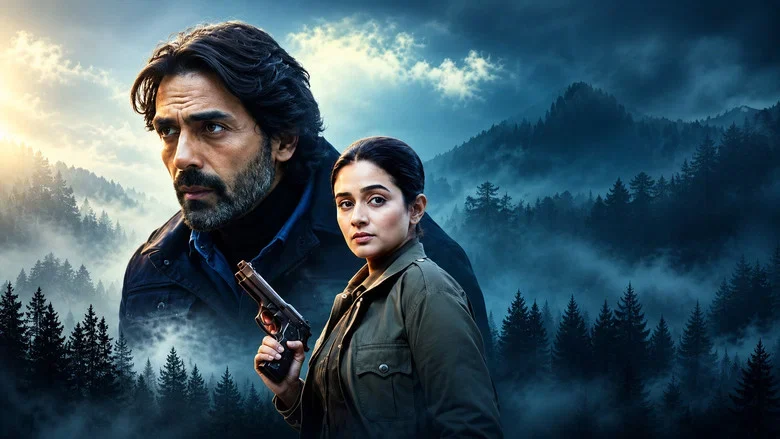
A suspended cop. A missing ₹5 crore. A Christmas night that refuses to explain itself. Sangeeth Sivan’s final film arrives on ZEE5 with the solemnity of a case file and the patience of a lecture.
Arjun Rampal plays Sikander Singh, a crime-branch officer stripped of his badge but not his instinct, and the film’s entire gravitational pull rests on whether that instinct can cut through a fog of contradictory testimony.
When a Suspended Cop Becomes the Only Adult in the Room
The opening movement wastes little time establishing Sikander’s authority, badge or no badge. He moves through rooms like a man who has already decided what everyone is hiding.
His encounter with Shaan, a young man whose friend Vicky is being squeezed by a criminal network, functions as the narrative’s ignition point. It is also the film’s cleanest stretch of storytelling.
Rampal understands something crucial about playing institutional men: the stillness matters more than the volume. His Sikander rarely raises his voice, and when he does, it lands with the weight of someone who has spent years being listened to.
That restraint echoes the quiet authority Priyamani brought to her role in G.D.N, where a similar economy of gesture did the heavy lifting that dialogue could not.
The Friend Group Problem: When Backstory Becomes a Barricade
Here is where Blind Game loses its footing. The extended Shaan-Vicky-friends track consumes enormous screen time, and the film treats every one of those minutes as essential.
They are not. The young men’s accounts contradict each other, which is theoretically the point, but the screenplay keeps explaining those contradictions rather than dramatizing them.
Akash Makhija’s Shaan carries the burden of being both entry point and exposition delivery system. Rohit Chandel’s Vicky exists primarily as a victim, which limits what any performer could do with the role.
By the time the alleged suicide enters the picture, the investigation has already been buried under its own procedural debris. The mystery should tighten. Instead, it sprawls.
Priyamani Grounds the Procedural While the Plot Spirals
Yamini, Priyamani’s police officer, reports to Sikander and provides the film with its only functioning counterweight. She is competent, unshowy, and entirely believable as someone who has learned to navigate institutional hierarchies.
Watch how she occupies space in interrogation scenes: arms crossed, eyes tracking, never performing intelligence but simply possessing it. It is a performance of accumulated professional habit rather than dramatic flourish.
The problem is that Yamini exists to support Sikander’s investigation rather than challenge it. A character this grounded deserved friction, not assistance.
David Walter Williams, the antagonist, operates as a reputation rather than a presence. His gang blackmails, his name intimidates, but the film never grants him a scene that justifies the fear he supposedly generates.
The villain remains a network, a threat vector, a name dropped in hushed tones. That can work. Here, it feels like avoidance.
Sivan’s Direction: Controlled Investigation, Uncontrolled Explanation
Sangeeth Sivan structures the film around withheld information, which is the correct instinct for a mystery. The camera stays close during interrogations, refusing the release of wide shots when tension should be building.
But the pacing betrays the premise. Long-winded explanations replace discovery, and the film keeps pausing to ensure the audience has understood what it just watched.
That instinct for clarity becomes a liability. A thriller should trust its audience to assemble the pieces. Blind Game keeps handing them over pre-assembled.
The Christmas-night setting establishes a temporal atmosphere that the film never fully exploits. What could have been a claustrophobic pressure cooker becomes a series of conversations in anonymous rooms.
Where a tighter genre entry like Reporting Live trusted its audience to track moral ambiguity without hand-holding, this film keeps stopping to check if everyone is still following.
A Remake That Loses the Discipline of Its Source
Blind Game is a Hindi remake of the Malayalam thriller 7th Day, and the comparison is instructive. The original understood that a mystery’s power lies in what it withholds.
This version relocates the story effectively, using Sikander’s suspended status as an institutional obstacle that adds texture to the investigation. That is a genuine improvement.
But the screenplay’s control is weaker. Where the source material moved with purpose, this adaptation meanders through explanations that should have been scenes.
The result is a film that honors its premise intellectually while failing to generate the visceral unease that the genre demands.
Soham Rockstar and ThunderSky Bet on OTT, Not Theatres
The film arrives on ZEE5 rather than in theatres, a distribution decision that makes commercial sense for a mid-budget procedural without spectacle set pieces.
Soham Rockstar Entertainment and ThunderSky Entertainment have produced a product suited to streaming’s longer attention window, where viewers can pause and rewind through the film’s tangled exposition.
That is not a compliment. A thriller that requires rewinding to follow its own plot has already conceded defeat on the tension front.
For Rampal, this represents a continuation of his OTT presence rather than a theatrical statement. His box-office leverage remains tied to projects with clearer genre hooks and more disciplined scripts.
The industry lesson is familiar: remakes require more than translation. They require the same ruthless editorial discipline that made the original work.
The Truth Is Out There, Buried Under Its Own Explanation
Blind Game ends with revelations that should land with force but arrive with the exhaustion of a case file finally closed. The missing money is accounted for. The suicide is explained. The connections are mapped.
What lingers is not the solution but the frustration of a film that had the pieces for something sharper.
Rampal’s performance deserves a better vehicle, one that trusts his stillness without asking it to compensate for a screenplay that cannot stop talking.
The film’s deeper failure is philosophical: it treats truth as something to be explained rather than uncovered, and in doing so, drains the mystery of its mystery.
Streaming audiences seeking a procedural with genuine tension will find moments here. They will also find themselves checking how much runtime remains.
In a landscape where contemporary hindi thrillers are learning to trust silence and ambiguity, Blind Game arrives as a reminder that some lessons remain unlearned.
The case closes. The credits roll. The feeling that something was missed persists.

Ankit Jaiswal is the Chief Author, covering Indian cinema and OTT releases with honest, no-filler criticism. An SEO strategist by background, he brings a research-driven approach to film writing, cutting through hype to tell you exactly what's worth your time.
Related Movies & Releases