Reporting Live (2026): Parineeti Chopra Anchors A Grimy Sand-Mafia Procedural That Trusts Its Silences

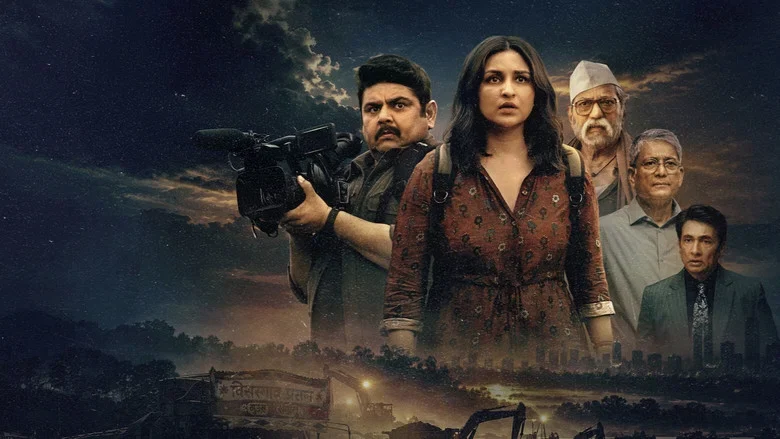
The sand doesn’t announce itself. It sits in the frame like sediment, gets scraped off riverbanks at three in the morning, gets loaded onto trucks whose plates have been painted over twice, and by the time Sandhya (Parineeti Chopra) realises what she’s actually chasing, the story has already metastasised from a fatal accident into a full-blown syndicate war. Dhruv Tripathi’s Netflix premiere opens not with a bang but with a body, and a reporter stubborn enough to keep asking questions the local police have already stopped asking.
That’s the correct entry point for this kind of film. Reporting Live isn’t interested in the mythology of the crusading journalist; it’s interested in the mechanics. Who drives the truck. Who signs the permit. Who picks up the phone when the story gets too close. The screenplay, co-written by Tripathi and Mihir Jadhav, treats illegal sand mining as an ecosystem rather than a metaphor, and that specificity is the film’s single most valuable asset.
A Cameraman’s Hesitation Is The Only Honest Reaction In The Room
Deven Bhojani’s Vinod is the film’s structural conscience. He’s the reluctant cameraman, the man who holds the rig, who frames the shot, who understands before Sandhya does that the lens is a weapon that points both ways. Bhojani plays him with a permanent half-step backward, shoulders angled slightly away from every conversation, fingers never quite settling on the record button. It’s a performance built entirely out of micro-retreat.
The dynamic works because the film refuses to make Vinod a coward. His hesitation is professional, not moral, he’s been on enough assignments to know that the camera is what gets you killed, not the questions. When he finally does raise the viewfinder in a mid-film confrontation, the gesture lands with more force than any punch the screenplay could have thrown. That restraint is what separates this from the noisier entries in the genre, and it’s a discipline the film shares with the chamber-piece pressure of Last Man in Tower, where menace lives in what nobody says out loud.
Parineeti Chopra Stops Performing Ambition And Starts Inhabiting It
Chopra has spent the last few years oscillating between glossy studio vehicles and roles that ask her to do very little beyond look determined. Sandhya is the first part in a while that asks her to sit still. Watch her in the early interview scenes: she doesn’t lean forward, doesn’t gesture, doesn’t do the reporter-movie thing of jabbing a pen at the subject. She just waits. The stillness is the interrogation.
By the second act, when the syndicate starts returning her calls in person, that stillness curdles into something harder. There’s a sequence where she’s asked to hand over her phone and she does it, slowly, deliberately, eyes never leaving the man asking, and the whole film’s thesis about power lives in that single unhurried movement. It’s a performance that understands the assignment is endurance, not heroism.
Where the film stumbles is in failing to give her a proper opposite number. The sand mafia remains a collective, a diffuse organisation of trucks and middlemen and one visibly nervous local fixer, and the absence of a singular antagonist drains the third act of the confrontational charge it’s clearly reaching for. Compare it to the operatic dual-role excess of Toxic, a film that overcorrected in the opposite direction, and you sense a screenplay that never quite decided how much villain it wanted.
The Ensemble Is Cast For Texture, Not For Function
Adil Hussain and Amol Palekar appear in the kind of roles that used to be called “gravitas cameos”, men who sit in rooms and imply institutional weight. Hussain gets one scene of quiet bureaucratic menace, Palekar gets a handful of lines that could have been delivered by anyone with a decent baritone. Neither is given enough to do, and the film’s generational casting starts to feel like a marketing decision rather than a dramatic one.
The same problem afflicts the supporting bench more broadly. Saswata Chatterjee, Nassar, Shekhar Suman, Pitobash Tripathy, these are performers who can steal a scene with a single glance, and here they’re deployed as set dressing. The film’s most effective supporting presence is actually the sand itself: the pits, the trucks, the dust that coats every interior, the way Tripathi’s camera keeps returning to the raw material as if the real antagonist were geological.
Tripathi Directs The Threat, Not The Action
For a first-time feature director working in a genre that rewards escalation, Tripathi shows unusual patience. He shoots the syndicate’s intimidation tactics at a distance, long lenses, figures at the edge of frame, the sound of a truck engine arriving before the truck itself. The result is a film that feels hunted rather than chased, and that tonal choice carries it through some fairly thin middle passages.
The problem is pacing. At just under two hours, Reporting Live spends too much of its second act moving between locations without escalating the stakes, and the eventual convergence of criminal and political interests lands with less force than the screenplay clearly intends. The procedural texture is excellent; the dramatic architecture is not. It’s the same trap that snared the otherwise sharp Chevittorma, where a strong central performance had to carry structural weight the script never fully distributed.
What The Ending Refuses To Give You
Without spoiling the final movement, it’s worth noting that Reporting Live ends on a note of qualified exposure rather than triumph. The story gets out. The syndicate doesn’t. That refusal to close the loop is the film’s most interesting decision, a recognition that the kind of corruption it’s documenting doesn’t end with a headline, it just changes trucks.
What it leaves you with is a portrait of journalism as a war of attrition, fought by people who are tired before they start. Chopra’s final close-up, silent, unsmiling, staring at something just off-camera, is the film’s thesis in a single frame. She hasn’t won. She’s just still standing, and the film is honest enough to admit that might be the whole victory.
In a landscape where contemporary hindi thrillers increasingly mistake volume for tension, this one at least knows the difference. It’s a flawed, over-cast, occasionally slack piece of filmmaking that nonetheless gets the central thing right: it treats its subject with the seriousness the subject deserves, and it trusts its lead actress to carry the weight without a single raised voice.
Rating: 3 / 5
Sand gets everywhere. So does the truth, eventually, but by the time it does, the people who dug it up have already been buried in the paperwork.

Ankit Jaiswal is the Chief Author, covering Indian cinema and OTT releases with honest, no-filler criticism. An SEO strategist by background, he brings a research-driven approach to film writing, cutting through hype to tell you exactly what's worth your time.
Related Movies & Releases