Udta Teer (2026): Ayushmann Khurrana’s Spy Comedy Fumbles Its Own Identity


The blast lands early. When Bilal opens his eyes, the man who slipped across the border to dismantle India now believes, with a convert’s fervour, that he was born to defend it.
That single reversal is the entire engine of Akash A. Kaushik’s spy comedy, and for a while it hums with genuine dramatic irony.
A Pakistani Operative Who Wakes Up Saluting The Wrong Flag
Dharma Productions and Sikhya Entertainment have backed a premise that sounds like a parlor trick and plays, in its opening stretch, like a dare.
Bilal enters India on a covert assignment; a blast wipes his memory; he resurfaces as a committed patriot with an infiltrator’s muscle memory intact. The film’s smartest early instinct is letting the audience sit on information its hero has lost.
Kaushik stages the aftermath as farce with a straight face, which is the correct register. The comedy doesn’t come from jokes so much as from the widening gap between what Bilal believes and what his body still knows how to do.
When Indian Agencies Recruit The Enemy They Should Be Hunting
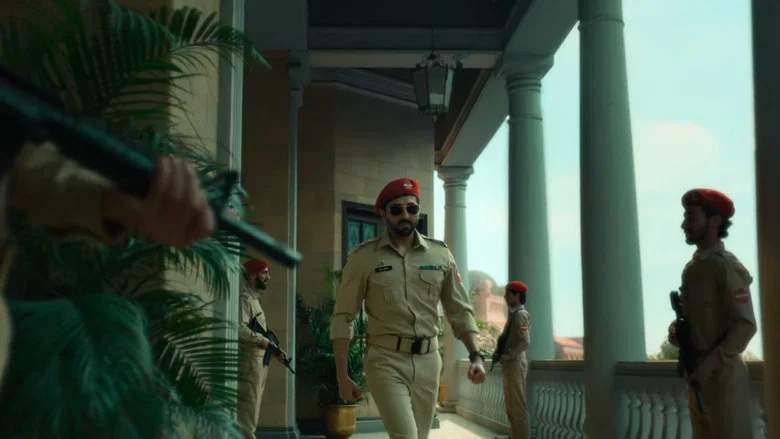
The second-act pivot is the film’s most audacious swing. Indian intelligence, blind to Bilal’s real background, finds him useful and folds him into their own operation.
It’s a reversal that inverts the standard spy thriller cleanly, and it generates the institutional comedy the premise promises. His original handlers, meanwhile, watch their own asset become a threat they can’t publicly disown.
This is where the screenplay’s delayed-information structure does real work, keeping three parties in the dark while the audience holds all the cards. It also raises the plausibility question the film never quite answers: how does a trained operative’s documentation, language and operational history survive the erasure of the identity that produced them?
The film waves the question away with a shrug and a punchline. That’s a defensible choice for a comedy, though it quietly lowers the stakes every time the plot leans on Bilal’s professional competence.
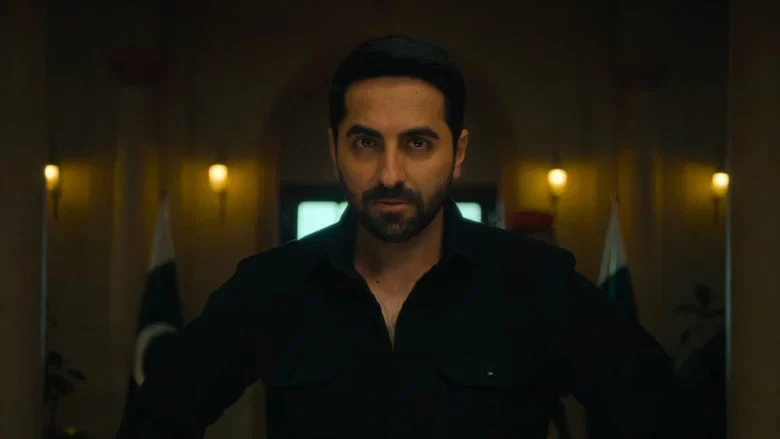
Khurrana Plays Two Men Inside One Skull, And Only One Of Them Is Funny
Ayushmann Khurrana’s Bilal is built on a performance contradiction, and he commits to it physically rather than verbally. Watch his posture in the recruitment scenes: the spine straightens into a soldier’s carriage while the eyes stay a half-second behind the room, processing a briefing he doesn’t remember earning.
He plays confusion without surrendering competence, which is harder than it sounds. The comic charge comes from his absolute sincerity, a man who has adopted a nationality as a personality and defends it with the fervour of the recently converted.
It’s a looser, more physical register than the wounded restraint he carried through Reporting Live, and it suits him. The problem is that the script keeps asking him to reset to the same comic beat rather than let the identity crisis deepen.
Sara Ali Khan’s Yamini, a CTS officer who never learns what the audience knows, is positioned as both investigator and romantic counterweight. She holds her interrogations with a flat, procedural calm that reads as institutional training, and the film is better when it lets her suspicion do the work instead of dialogue.
The supporting ensemble is largely decorative. Rahul Bose and Ram Kapoor appear in scenes that require them to react to Bilal’s patriotism rather than shape it, and the film never gives the institutional machinery a face worth fearing.
The Tonality Problem Buried Under All That Chaos
Kaushik directs with a magazine-editor’s instinct for rhythm: quick cuts, blast imagery, a three-minute-and-change package of espionage action and comic escalation. It moves.
What it doesn’t do is modulate. The film treats every scene at the same pitch, so a genuine threat from Bilal’s handlers lands with the same weight as a mistaken-identity gag.
The tonal risk here isn’t hypothetical, it’s structural. When comic misunderstanding repeatedly undercuts the espionage stakes, the audience stops fearing the danger and starts waiting for the next punchline.
That flattens the third act before it arrives. The film’s central tension should be whether memory, training or adopted belief controls Bilal’s actions, and the direction never lets that question breathe long enough to sting.
It’s the same tonal discipline problem that has dogged the recent wave of Awarapan 2-style crime dramas, where atmosphere substitutes for escalation. Here the substitute is jokes.
Dharma’s Bet On High-Concept Comedy In A Crowded October
For Dharma and Sikhya, this is a calculated swing at the mainstream comedy slot, and the opening-day tracking, a modest ₹2–3 crore range, suggests the bet hasn’t yet paid off at the scale the banner is used to.
The release itself was shuffled twice, from September to October and then to the 23rd, which rarely signals confidence in a film’s commercial footing. Khurrana remains a bankable theatrical draw, but his leverage depends on the film delivering the crowd-pleasing clarity his best comedies have.
Against the broader landscape of contemporary Hindi action, this one arrives with a clever hook and no clear second gear. That’s a risky position for a star vehicle in a market that rewards either spectacle or sharp writing, rarely both.
The comparison to a streaming title like The Dropout Surges 400 is instructive only in one respect: audiences now reward projects that commit to a single tonal register. This film commits to three and masters none.
The Verdict: A Clever Premise That Forgets To Remember Its Own Stakes
Udta Teer has the bones of a sharp satire about how patriotism is just a label the memory happens to be wearing. It never quite finds the nerve to say so.
What remains is a likable, fitfully funny star comedy that mistakes a good idea for a finished screenplay. Khurrana’s performance is worth the ticket; the film around him keeps forgetting what it’s about.

Ankit Jaiswal is the Chief Author, covering Indian cinema and OTT releases with honest, no-filler criticism. An SEO strategist by background, he brings a research-driven approach to film writing, cutting through hype to tell you exactly what's worth your time.
Related Movies & Releases