Pehla Pyaar Doosri Baar (2026): Sparsh Walia’s Reunion Rom-Com Runs on Fumes

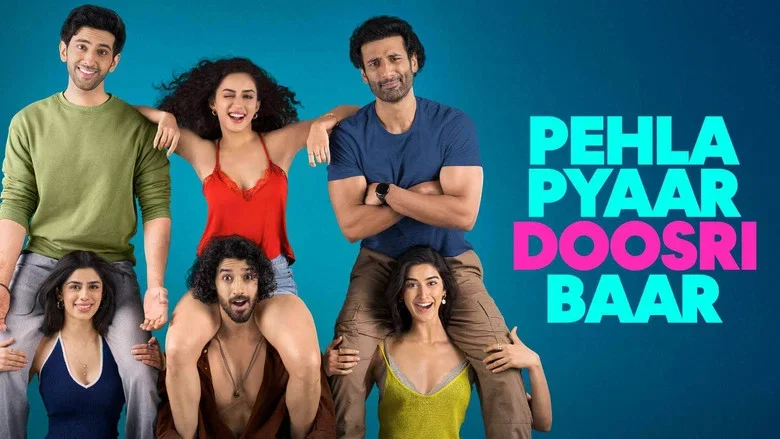
Anuj Saini’s reunion comedy opens on a Delhi office floor where three colleagues watch their peers disappear into wedding invitations and appraisal letters. Then comes the drunken pact: drive to the hills, resurrect the crushes that never resolved.
Three Crushes, One Road Trip, Zero Real Stakes
Sparsh Walia’s Gautam, Kunal Vaid’s Vedant and Sargun Kaur Luthra’s Shivi share a corporate purgatory of targets and promotions before the reunion detour. The premise is clean: three adults treating unfinished school business as an urgent mission.
The film then splits into three parallel pursuits, and the split is where the trouble starts. Each track is given roughly equal weight, so none of them accumulates the pressure a single romance would.
When Intimacy Becomes A Commitment Trap
Gautam’s reunion with Gehna is the film’s most promising thread. Alisha Chopra plays her as blunt, flirtatious and freshly bruised, and she gets the best line in the movie: “Hot hona bhi bohot badi problem hai.”
Then comes the reversal. Gehna asks for permanence, and Gautam’s face closes like a shop shutter. It is a recognisable beat, executed with competence but no surprise; the screenplay mistakes hesitation for complexity.
Vedant’s track runs on a harder clock. His confession to Simran lands, their bond deepens, and then her fiancé Vikesh arrives to convert the romance into a countdown. Gobind Singh Mehta plays Vikesh with the flat confidence of a man who has already won.
The Makeover That Gives The Game Away
Shivi’s arc is the most exposed. She hears Karan call her “cute, ” decides that word is a friend-zone verdict, and remakes herself to be read as “sexy” instead. Tushar Chhibber’s Karan is a serial womaniser who takes what is offered and offers nothing back.
The film wants this to sting, and Luthra does find genuine hurt in the aftermath. But the staging keeps returning to surfaces, and the emotional cost of the makeover is never examined with the seriousness the performance earns.
A Friendship That Outruns The Romances
What holds the middle section together is the trio itself. Their post-mortem scenes, three disappointed adults comparing wounds, carry more charge than any of the couples they are chasing.
This is where the film’s structural debt becomes visible. The parallel tracks never combine into real escalation, and the ensemble’s warmth ends up doing work the romantic writing should have done itself.
Mussoorie Postcards And A Score Doing Heavy Lifting
Saini shoots the hills as nostalgic postcard: wide frames of pine and mist that contrast deliberately with the fluorescent flatness of the Delhi office. It is pleasant and entirely without tension.
The music, widely noted as the film’s strongest asset, arrives to smooth over the joins. Every time a scene risks going flat, a melody steps in to tell you what to feel.
The film’s tonal range sits closer to the grimy, grounded procedural instincts of Reporting Live than its own marketing suggests; both trust atmosphere over incident, though only one earns it.
That reliance on sonic cushioning is the same crutch visible in the franchise-comedy space, where familiarity is mistaken for warmth, as the sequel treadmill of Dhamaal 4 demonstrates.
Newcomers Who Deserve A Sharper Script
The cast is the film’s genuine asset. Walia has a soft, watchful quality that makes Gautam’s retreat legible without dialogue, and Luthra’s refusal to play Shivi as ingratiating is the most interesting choice on screen.
Chopra’s Gehna, meanwhile, has the film’s clearest grip on adult disappointment, delivering her demand for commitment with a stillness that makes Gautam’s flinch look childish. The ensemble’s restraint echoes the quiet control that anchors Drishyam 3, though here the material gives them far less to hold.
Luv Ranjan’s Banner And The Remake Economy
With Luv Ranjan’s production muscle behind it, the film is positioned squarely in the friendship-rom-com lane his banner has mined for over a decade. The commercial bet is on low-budget goodwill rather than star draw.
That bet looks fragile. A live opening-day India net of roughly ₹0.22 crore is not a number that sustains a theatrical window, and the newcomer-led model only pays off when word of mouth ignites.
Against the current exhibition market, where franchise sequels crowd screens, an original romantic comedy with no established face needs either a genuine critical surge or a music-driven cultural moment. This one has the songs and not much else.
The Ending That Refuses To Grow Up
The climax redirects all three friends toward helping Vedant win Simran back before her wedding concludes. It is generous, communal and faintly evasive, since the film never quite decides whether nostalgia is a wound or a hobby.
What lingers is the gap between the film’s thesis and its execution. It argues that first love is a fantasy adults must outgrow, then indulges that fantasy for two hours without asking anyone to pay for it.
For a genre currently rediscovering adult texture across contemporary Hindi comedy, this is a step sideways rather than forward. Charming company, thin conviction, and a reunion you will forget before the drive home.

Ankit Jaiswal is the Chief Author, covering Indian cinema and OTT releases with honest, no-filler criticism. An SEO strategist by background, he brings a research-driven approach to film writing, cutting through hype to tell you exactly what's worth your time.
Related Movies & Releases