DNK (2026): Mouli Tanuj Prashanth’s Debt-Fuelled Crime Comedy Runs on Borrowed Time


The first image DNK plants in your skull isn’t a heist, it’s a phone screen glowing in a dark bedroom, a betting app quietly eating a young man’s future one tap at a time.
By the time Eeshwar is sprinting from a jewellery shop with a bag he can barely hold, the film has already made its thesis clear: easy money is the most expensive thing he’ll ever chase.
When the Villain Is a Notification, the Stakes Start Sliding
Sreenu Kambala’s debut opens with real teeth. Eeshwar, a B.Tech dropout, funnels borrowed money into online betting and app-based loans until his girlfriend’s father is standing in his living room demanding repayment.
That confrontation is the film’s sharpest scene, private shame made public, a middle-class household frozen around a debt it can’t explain away.
Mouli Tanuj Prashanth plays that humiliation with a slack jaw and darting eyes, the body language of a boy who has run out of excuses before he has run out of apps.
The trouble is what comes after. Once the film pivots to house robberies, the debt, so specific, so contemporary, dissolves into generic farce.
Kambala trades the sting of a real economic crisis for slapstick complications, and the result feels like a film that lost its nerve at intermission.
The Comic Engine Sputters When Everyone Is a Punchline
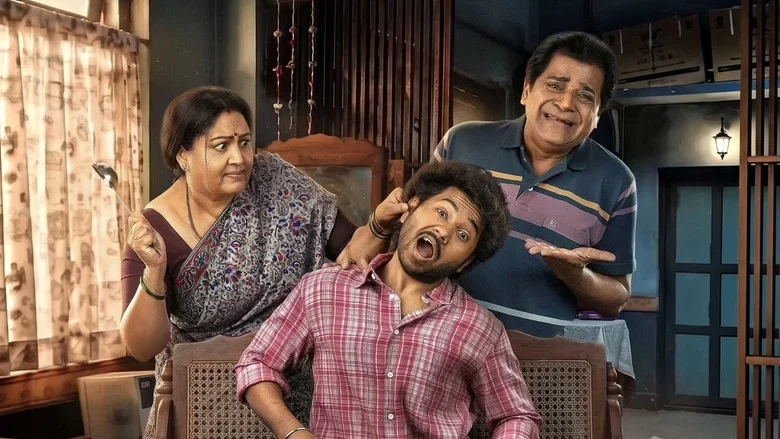
Ali and Rajitha are drafted in to keep the laughter flowing, and both land their beats. But the ensemble is written as a chorus of reaction shots rather than people with their own wants.
Eeshwar’s money-minded parents, his panicking friend, the lenders who should feel genuinely threatening, all of them exist to bounce comedy off the protagonist and then vanish.
Worse, there’s no antagonist. The film distributes its opposition across debt collectors and bad decisions, which is thematically interesting and dramatically limp.
You can’t hiss at a loan app. You can’t fear a spreadsheet.
The screenplay’s escalation logic, every solution breeds a bigger problem, is sound on paper, but the robberies are staged with such frantic energy that consequence never has room to settle.
Compare it to the tighter pressure-cooker discipline of Law Abiding Citizen Leaves, where every escalation costs someone something permanent.
Sushmitha Shetty Is the Film’s Conscience, and It Barely Uses Her
She is the emotional counterweight the story needs, the girlfriend whose savings and trust Eeshwar treats as a personal ATM. Her stillness in the repayment scene, hands folded, refusing to meet his eyes, is the most adult moment in the film.
Then the script sidelines her. Once the robberies begin, she becomes a voice on the phone, a worried face in a doorway, a plot device waiting to be apologised to.
That’s a structural betrayal, not an acting one. Shetty’s chemistry with Mouli in the lighter scenes, the teasing, the shared glances over cheap food, suggests a warmer film than the one we got.
The same wasted potential hangs over the family comedy. The parents are written as caricatures of greed, when a more honest version would show them as the very people whose thrift Eeshwar is betraying.
Kambala Directs the Panic, Not the Consequence
For a debut, the craft is competent without being distinctive. The camera pushes in on Mouli’s face whenever a lie is about to collapse, a reliable trick that starts to feel mechanical by the third act.
Lighting stays bright and sitcom-flat even in the robbery sequences, which undercuts any genuine danger, these aren’t criminals, they’re boys playing dress-up, and the film never decides whether that’s tragic or funny.
The editing in the first half has a decent rhythm, letting the debt spiral breathe through small domestic details. The second half sprints, cramming reversals into montage until the climax arrives without real weight.
Where the film finds its footing is in the observational comedy of middle-class embarrassment, the neighbour who knows too much, the father-in-law who won’t sit down.
Where it loses it is in the fantasy of the heist, which feels borrowed from a dozen other Telugu crime comedies without adding anything to the template.
The tonal whiplash recalls the uneven ambitions of Dongamohan, another recent Telugu crime vehicle that couldn’t reconcile its comic instincts with its darker premise.
Mouli Carries the Film on Charm, and Charm Has Limits
There’s a moment when Eeshwar realises his girlfriend has stopped lending him money, not with anger, but with quiet exhaustion. Mouli’s face does something interesting there: a flicker of panic, then a defensive smile, then nothing.
That blankness is the performance’s smartest choice. He plays a boy who has learned to feel nothing about money because feeling something would require changing.
But the role demands a transition from comic scrounger to genuine criminal, and Mouli doesn’t quite make the leap. His Eeshwar remains a kid in over his head, which is sympathetic but limits the film’s dramatic reach.
The physical comedy is strong, the awkward run, the guilty flinch, the way he shrinks when his father raises his voice. The emotional register stays narrow.
For a more complete portrait of a young person crushed by economic pressure, look at the grim, lived-in texture of Reporting Live, where the desperation has actual weight behind it.
Mythri’s Gamble on a Newcomer’s Voice
Mythri Movie Makers is a banner built on star vehicles and large-scale entertainers. Backing a first-time director with a mid-budget crime comedy is a calculated diversification play.
The commercial logic is clear: low overhead, a young lead with a social-media following, and a premise that speaks directly to an audience drowning in EMI apps and betting ads.
But the theatrical market for Telugu crime comedy is brutally crowded, and DNK lacks the star power or the genre novelty to break through on branding alone.
Mouli’s box-office pull is unproven, and the film’s opening weekend will depend almost entirely on word-of-mouth from younger viewers who recognise the debt spiral it depicts.
The title change from Donga Naa Koduku to the abbreviated DNK suggests a production team nervous about how the film is perceived before it’s even seen.
That anxiety is visible in the finished product. This is a film that wants to be both a cautionary tale and a crowd-pleaser, and it doesn’t fully commit to either.
Across contemporary Telugu crimes on screen, the ones that endure are those willing to sit with discomfort rather than sprint past it.
The Uncomfortable Truth DNK Almost Says Out Loud
The film’s final act wants us to believe Eeshwar has learned something. But the resolution arrives too easily, too cleanly, as if the debt and the lies and the borrowed trust can all be settled with one last lucky break.
That’s the film’s real failure of nerve. It sets up a genuinely modern crisis, the way financial apps have made ruin feel like a game, and then resolves it with the logic of a fairy tale.
The uncomfortable question DNK raises but refuses to answer is whether a boy who treats money as a fantasy can ever learn to live in reality.
Kambala has the instincts of a storyteller who understands shame, family, and the seduction of easy profit. What he lacks is the willingness to let his protagonist actually lose something he can’t get back.
Until Telugu cinema allows its debt-ridden heroes to face real consequences, films like this will keep borrowing from better ones, and never quite repaying the debt.

Ankit Jaiswal is the Chief Author, covering Indian cinema and OTT releases with honest, no-filler criticism. An SEO strategist by background, he brings a research-driven approach to film writing, cutting through hype to tell you exactly what's worth your time.
Related Movies & Releases