Life of Pi Ending Explained: The Tiger, The Cook, And What Richard Parker’s Exit Really Means

The tiger does not look back. That is the last thing the film gives us before the frame cuts away from the beach, Richard Parker walking into the Mexican jungle, vanishing into the vegetation without a flicker of recognition, while Pi sobs in the sand behind him. Everything the movie has built across 227 days collapses into that one refusal. The animal that kept him alive, that gave his isolation a heartbeat and a silhouette, leaves like a stranger catching a train.
Two Hundred Days In A Lifeboat Built From Grief And Rope
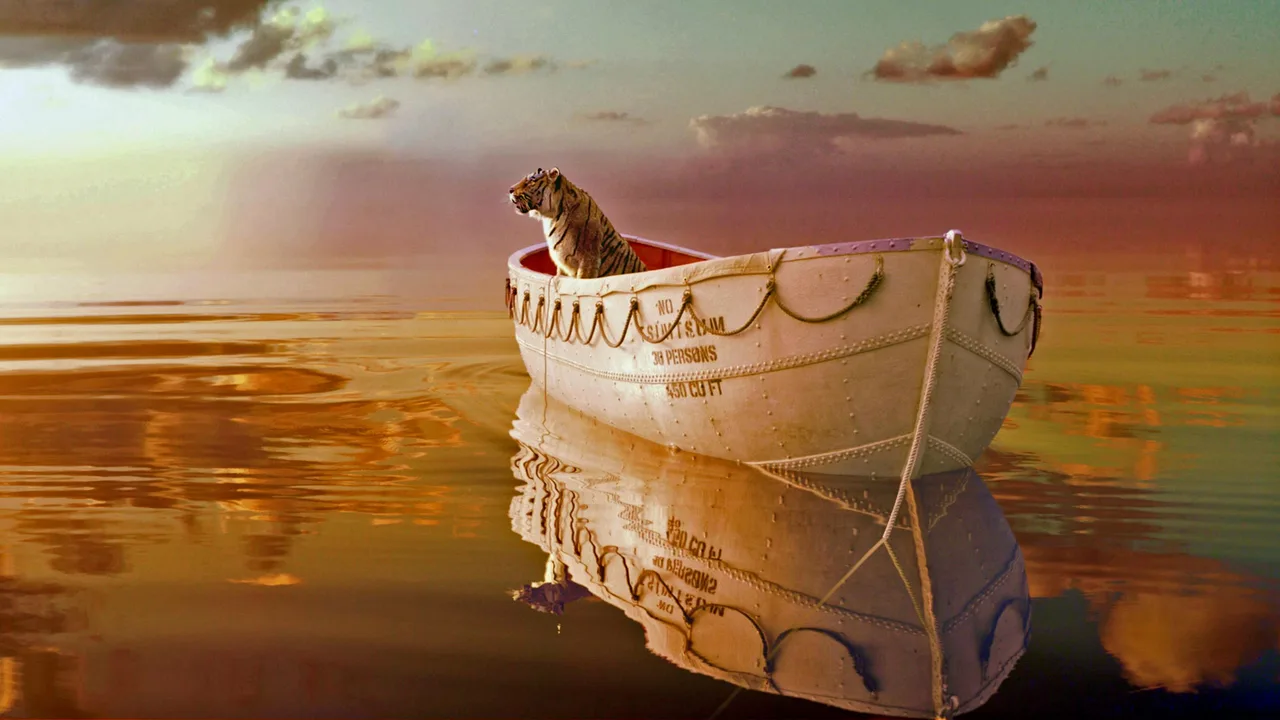
Ang Lee constructs the entire third act as a slow squeeze. The lifeboat shrinks visually with every passing reel, the raft lashed to the hull, the tarpaulin pulled taut, the supply cans scraped down to rust. Pi’s authority over Richard Parker is never brute force; it’s a rhythm. The whistle, the rocking of the boat, the tossed fish, the demarcated territory marked by urine and sheer nerve. Each gesture is a small treaty renegotiated daily.
The film’s survival mechanics carry a strange tenderness that most open-water pictures miss entirely, resisting the frantic tonal shifts that undermined recent experiments like numbers-driven survival dramas. Lee lets the camera sit in the heat. Sweat beads on Pi’s forehead. The tiger’s ribs show through matted fur. There’s no montage cheat, no music swelling to rescue the audience from the monotony of thirst.
When A Beach Becomes The Cruelest Possible Ending
Land arrives as a betrayal, not a rescue. Pi drags himself onto the sand, his body a scarecrow of bone and salt, and Richard Parker steps past him toward the treeline. The camera holds on the tiger’s back, no glance, no pause, no narrative courtesy. Just paws on wet sand and then green swallowing orange.
Lee stages this with unbearable stillness. No score cue punches the moment. The waves keep doing what waves do. Pi’s cry is small and human against the vast indifference of the coastline, and the sound design strips everything else away until all we hear is a boy calling a name that will never answer back. It’s the most devastating exit in the film, and it happens without a single line of dialogue explaining its weight.
The Second Story That Rewrites Everything You Just Watched
Then the hospital room. Two Japanese investigators, clipboards in hand, rejecting the animal account as insurance-report nonsense. Pi gives them what they want, and what he gives them is worse. The zebra becomes a wounded sailor with a broken leg. Orange Juice becomes Pi’s mother. The hyena becomes the cook. And Richard Parker becomes Pi himself, or the part of Pi that did what had to be done.
Watch the earlier scenes again with this in mind and the breadcrumbs are everywhere. The cook’s cruelty on the deck before the sinking. The way Pi’s mother physically interposes herself between her son and danger. The hyena’s attack on Orange Juice mirrors a murder the film never shows directly, it just gives us an orangutan floating away on a bundle of bananas, and lets us do the arithmetic ourselves.
The tiger’s violence, then, isn’t the violence of nature. It’s the violence of a teenage boy who watched his mother die and decided, in some wordless chamber of himself, that he would not be next. Richard Parker is not a metaphor the film announces. He’s a body the film gives to something Pi cannot say out loud.
Who Walked Off That Beach And Who Didn’t
Pi survives, but the film is honest about what survival cost him. He builds a life in Canada, marries, has children, tells his story to a writer with a kind of practiced calm. That calm is the tell. He has learned to hold the two versions of his life in the same hands without letting them touch.
Richard Parker’s fate is the film’s sharpest cruelty. He lives. He walks into the jungle and is never seen again. No capture, no corpse, no proof either way. Whether he was a tiger or a piece of Pi’s soul, his exit marks the moment the survival identity retires, and it retires without thanking anyone.
The mother dies in both versions. So does the sailor. So does the cook, killed by Pi in the human account and by Richard Parker in the animal one, the same act, dressed in two costumes. The investigators walk away with the story they can file. The Canadian writer walks away with the story he prefers. Only Pi walks away with both.
Why The Tiger Never Turns Around
Lee shoots the jungle exit in flat, unforgiving daylight. There is no golden-hour romanticism, no slow-motion farewell. The tiger simply leaves, and the film refuses to soften it. That refusal is the whole point. Survival instincts do not offer gratitude. They do not explain themselves. They keep you alive and then they go.
Pi’s grief on the beach isn’t really about the tiger. It’s about the part of himself he needed to become, and the fact that this part will never sit down with him and say it was worth it. The film’s visual language reinforces this everywhere: water as both womb and grave, the lifeboat as a floating confessional, the reflective surface of the ocean constantly doubling the sky and hiding whatever is underneath.
Across contemporary cinema, few directors trust silence this completely. Lee lets the audience carry the moral weight instead of assigning it, which is why the ending still generates arguments over a decade later.
The Question Pi Refuses To Answer
Pi never confirms which story is true. He asks the investigators which they prefer, and they choose the animals. That’s not a dodge, it’s the film’s actual thesis delivered as a shrug. The audience is placed in the same chair as the insurance men, forced to pick the version of suffering we can live with.
Some viewers read the human account as literal fact and the animal account as a trauma narrative Pi constructed to survive his own memories. Others insist the tiger was real, that the film gives no hard evidence otherwise, and that reading Richard Parker as pure metaphor robs the story of its wonder. Both readings hold. The movie built a frame wide enough for both.
The strongest evidence for the human version sits in Pi’s physical reaction when he tells it. His voice flattens. His eyes go somewhere else. He doesn’t cry during the animal story. He cries during the human one.
Saltwater, Sand, And A Story With No Sequel
There is no mid-credits scene. The film ends where it began, with a man in Montreal telling a writer about a boy in a lifeboat, and a tiger who walked away without saying goodbye. The story is closed. The interpretation is not.
That’s the rare shape of this film. It’s a blockbuster built on ambiguity, a visual spectacle that trusts its audience to sit with an unanswered question instead of demanding a franchise. The final image isn’t the tiger or the beach. It’s Pi’s face as he finishes the telling, and the quiet understanding that he has been carrying both versions of his life for decades without ever needing anyone to confirm which one was real.
Pi Patel survived the Pacific, the hunger, the tiger, and the truth. What he never got was the goodbye. He built an entire life on top of that missing moment, and the film lets him keep it, unresolved, unthanked, and entirely his own.

Ankit Jaiswal is the Chief Author, covering Indian cinema and OTT releases with honest, no-filler criticism. An SEO strategist by background, he brings a research-driven approach to film writing, cutting through hype to tell you exactly what's worth your time.
Related Movies & Releases