Ramayana: Rise of a Legend (2026): Ranbir Kapoor’s Divine Restraint Can’t Tame a Franchise That Forgets to End

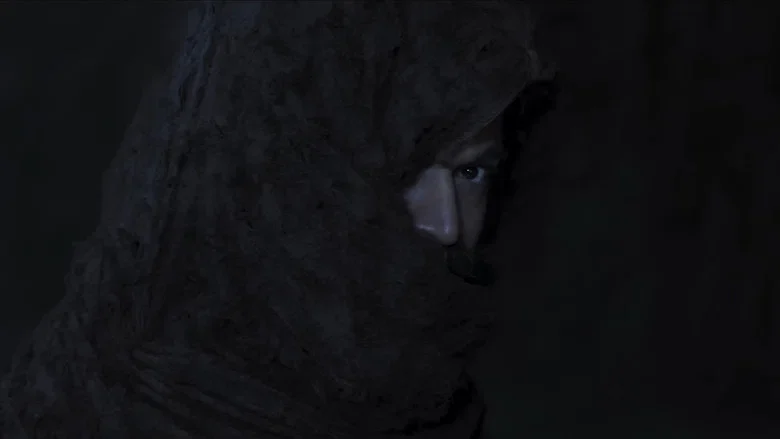
The first sound in Nitesh Tiwari’s Ramayana is a celestial argument, Devas and Asuras locked in a cosmic quarrel that will eventually birth a prince and a demon king. By the time the credits roll some two hours and forty-five minutes later, you realize that argument hasn’t finished.
That’s the structural gamble at the heart of this lavishly mounted first instalment, and whether you forgive it depends entirely on what you walked into the theater expecting.
A Demon King Who Begins as a Freedom Fighter, and the Film That Believes Him
The screenplay’s boldest move is chronological generosity toward Ravana. We meet him as an Asura child shaped by oppression, his devotion to his people explicitly framed as a liberation struggle against Deva dominion.
His prayer for power isn’t villainous posturing, it’s the desperate arithmetic of an enslaved clan. When that prayer curdles into territorial conquest, the film makes its thesis visible: freedom pursued through domination becomes indistinguishable from the tyranny it opposed.
Yash plays this arc with a stillness that’s genuinely unsettling. Watch his eyes in the throne-room sequences, they don’t blaze, they calculate, and the calm registers as a man who has already decided what your suffering will cost him.
It’s a performance built on vocal register rather than volume, and it recalls the brooding physicality he brought to Toxic, where the menace lived in posture rather than dialogue. Here, the posture is regal and the menace is theological.
Ranbir Kapoor’s Rama Is a Study in Restraint, Perhaps Too Much Restraint
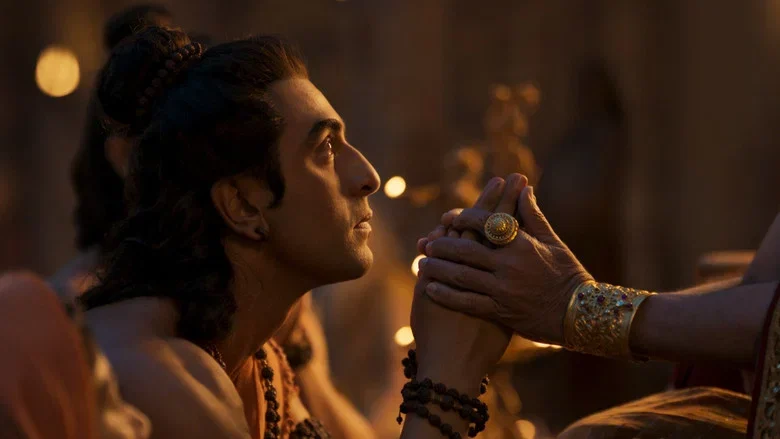
Kapoor’s Rama is defined by what he withholds. In the Ayodhya court sequences, he stands at a careful distance from his father’s throne, hands folded, voice pitched low, a prince rehearsing obedience before he’s asked to embody it.
The transition to exile is where the performance deepens. The wilderness doesn’t loosen him; it sharpens him, and the film finds its emotional anchor in the quiet domesticity of Rama, Sita and Lakshman sharing a meal under open sky.
Sai Pallavi’s Sita is positioned as a participant in the journey rather than a decorative consort, and her physical ease in the forest sequences, unbothered by mud, unimpressed by grandeur, gives the exile a lived-in texture.
Ravi Dubey’s Lakshman registers as loyal martial presence, though the screenplay gives him little to do beyond vigilance. Sunny Deol’s Hanuman is a casting promise the film doesn’t fully cash in this instalment, appearing with the weight of a delayed entrance.
When Every Frame Is a Painting, the Painting Starts to Compete With the People
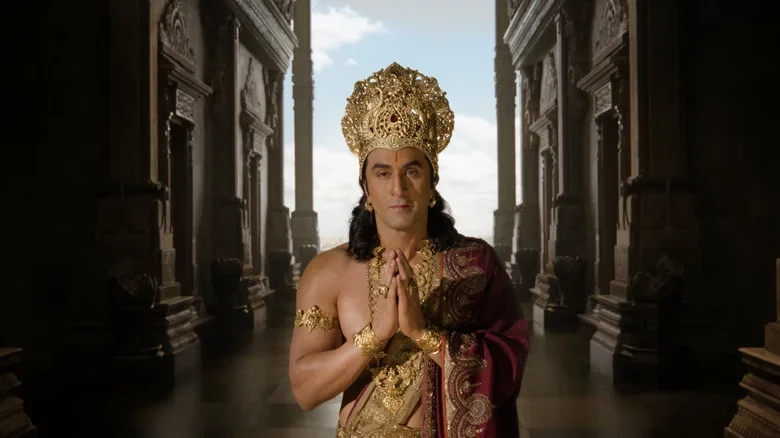
The CGI is the film’s most contested terrain, and the reasons are visible on screen. Ayodhya is rendered in gold and marble that gleams with a suspicious uniformity, while Lanka’s spires feel modeled from a global fantasy template rather than a devotional imagination.
The Deva–Asura realms fare better, their cold blues and volcanic oranges at least carrying a visual logic. But the human-scale scenes, a marriage, a farewell, a mother’s silence, are where the film breathes, and those are the scenes the effects work rarely touches.
Hans Zimmer and A.R. Rahman’s score is doing enormous emotional labor here, swelling beneath exile transitions and pulling back during confrontations. Where the sound design succeeds is in its silences, the moment before Ravana speaks carries more tension than any battle cue.
The first half is exposition-heavy by necessity, introducing cosmic order, Ravana’s origin, and Rama’s divine-human duality. The second half loosens into adventure, but the two-part architecture means major payoffs are deferred rather than delivered.
The Incomplete Story Problem, and Why the Title Doesn’t Help
Marketing the first instalment as “Rise of a Legend” rather than foregrounding its two-part structure is a choice with consequences. Audiences expecting the full Ramayana arc will find themselves at a continuation point, not a resolution.
This is where the film’s ambition becomes its liability. The screenplay wants to establish mythology, multiple divine factions, royal succession, and an incomplete epic within one sitting, and the strain shows in the pacing.
Comparatively, the tonal confidence on display here is a notch above the scattered world-building of Nayyi Navelli, another contemporary Hindi fantasy that struggled to balance domestic intimacy with larger mythological stakes. Tiwari’s film at least knows where its emotional center lies.
The revisionist framing of Ravana as a liberator-turned-conqueror will invite debate, and that’s healthy. What’s less healthy is the film’s refusal to commit to a single climactic confrontation, leaving the audience suspended rather than satisfied.
What Nitesh Tiwari’s Scale Means for the Studio Balance Sheet
Namit Malhotra’s production, with DNEG’s visual-effects infrastructure and Sony Pictures Releasing handling international distribution, represents a significant financial bet on mythological IP as a theatrical event.
The IMAX positioning and multi-language release strategy, Hindi, Tamil, Telugu, Kannada, Malayalam, signal an attempt to replicate the pan-Indian franchise model that has worked for other mythological properties, with the added pressure of international expectations.
For Tiwari, this is a dramatic departure from the grounded interpersonal dynamics of Dangal, and the question is whether his instincts for intimate human drama can survive the demands of a CGI-heavy epic franchise.
The theatrical exhibition market for Indian mythological fantasy is warming, but the two-part structure means the first film must generate enough goodwill to sustain anticipation for the second. That’s a commercial risk the producers have accepted.
Across contemporary Hindi fantasy, the pattern is clear: scale attracts audiences, but emotional specificity keeps them. This film has the first and is still searching for the second.
The Verdict: A Magnificent Opening Argument That Forgets to Close
Ramayana: Rise of a Legend is a film of genuine visual ambition and one extraordinary performance, Yash’s Ravana, a study in political corrosion that deserves a complete narrative to inhabit.
What surrounds him is often beautiful, occasionally inert, and structurally incomplete by design. The exile sequences carry real emotional weight, and Kapoor’s restraint is a deliberate choice that pays off in the film’s quieter moments.
But a first instalment must earn its incompleteness, and this one sometimes mistakes scale for substance. The CGI spectacle is impressive without being transporting, and the screenplay’s deferral of major payoffs feels less like confident serialized storytelling and more like a bet on audience patience.
See it in IMAX if you can, the cosmic realms and battle staging are built for that scale. But go in knowing you’re watching a prologue, not a complete epic, and that the film’s most compelling character is the one you’re meant to oppose.
When Ravana stands in his throne room, surveying a kingdom he liberated and then conquered, the film briefly achieves what it’s reaching for: a portrait of how righteous anger becomes empire. That moment lingers longer than the credits do.

Ankit Jaiswal is the Chief Author, covering Indian cinema and OTT releases with honest, no-filler criticism. An SEO strategist by background, he brings a research-driven approach to film writing, cutting through hype to tell you exactly what's worth your time.
Related Movies & Releases