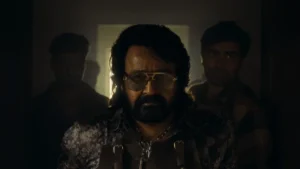
Bachelor Party D’eux (2026): Amal Neerad’s Ensemble Returns, but the Escape Never Quite Ignites


Amal Neerad opens on a knot of bodies moving through rain-slicked concrete, the camera hugging shoulders and elbows before it ever finds a face. The promise is immediate: this is a film about a group, not a hero.
What follows is a crime-comedy that keeps its loyalty thesis close and its dramatic pulse frustratingly distant.
A Spiritual Successor That Inherits the Swagger but Not the Sting
The film is positioned as a new chapter in the Bachelor Party lineage, and Neerad leans into that inheritance with visible pleasure. The ensemble moves as a unit, trading insults and covering each other’s exits with the ease of men who have done this before.
But inheritance is not invention. The screenplay treats friendship as a survival mechanism, which is a genuinely interesting idea, yet it rarely dramatizes the cost of that mechanism. The group refuses to leave a member behind, and the film repeats that refusal as a refrain rather than testing it.
Where a tighter film might have let one member’s weakness fracture the pack, this one keeps the pack intact and the tension polite. The stakes are announced, not felt.

Kunchacko Boban Anchors the Chaos While the Film Around Him Drifts
Kunchacko Boban carries the film’s centre with a physical stillness that reads as authority. In the quieter moments, he lets his shoulders drop and his voice settle into a low register, and the film briefly finds a pulse.
That restraint echoes the psychological weight he brought to Unmadham, where his character’s calm was a weapon. Here, the calm is the point, but the screenplay never gives it a worthy adversary.
The supporting ensemble is large enough to blur. Soubin Shahir gets the film’s best comic beat, a muttered complaint delivered while crouched behind a car door, and Sharafudheen registers in a single tense exchange before the film moves on.
The rest of the group functions as texture rather than character. The film’s royal relatives of the criminal underworld, so to speak, arrive, threaten, and recede without leaving a mark.
The Escape Mechanics Work Better Than the Comedy Around Them
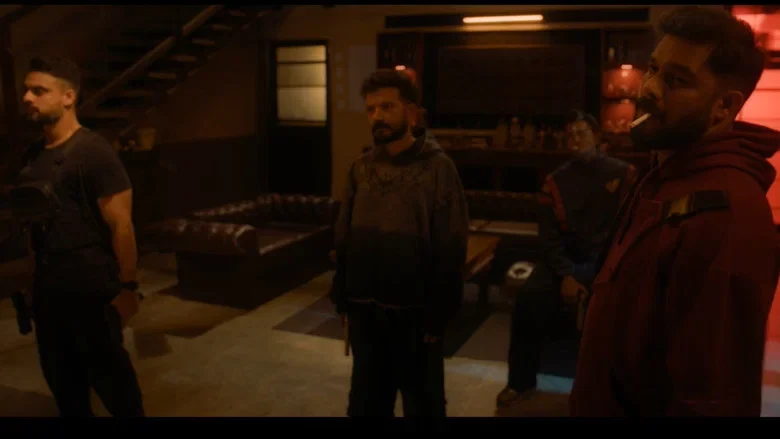
Neerad stages the pursuit sequences with a clean spatial logic. He keeps the camera low, uses foreground obstructions to compress the frame, and lets the group’s coordinated movement do the storytelling.
The problem is tonal. The comedy and the danger sit in adjacent rooms and rarely share a scene. When the film cuts from a tense corridor to a throwaway joke, the release is too easy, and the pressure dissipates.
This is the same imbalance that hobbled Disco, another Malayalam thriller that mistook forward motion for momentum. Both films confuse a busy plot with a propulsive one.
Amal Neerad’s Visual Discipline Deserves a Sharper Script
Neerad’s craft remains intact. He shoots faces in tight frames, lets silence hold a beat longer than expected, and uses the city’s wet surfaces as a mirror for the group’s fraying nerve.
The editing, however, betrays the atmosphere. The first half moves in fits, introducing characters and complications without letting any single scene breathe long enough to land.
By the second half, the film accelerates toward its escape, and the acceleration exposes the weakness. The climax is a sequence of obstacles rather than a confrontation, and the group’s loyalty is affirmed without ever being genuinely threatened.
That is the film’s central frustration. It wants to be about friendship under pressure, but it is too protective of its characters to apply the pressure.
The Box-Office Gamble of a Beloved Franchise
The film arrives with the weight of a spiritual successor behind it, and that is both its commercial asset and its creative liability. Nostalgia for the 2012 original will fill opening-weekend seats.
But the Malayalam industry’s current appetite for ensemble crime thrillers is not infinite. A film like this needs word-of-mouth to sustain beyond the first week, and word-of-mouth depends on scenes that audiences want to replay.
This one offers few. The ensemble is a draw, but the film’s theatrical leverage rests on star power rather than on a moment that demands retelling. That is a fragile position for any release.
The broader trend across contemporary Malayalam thrillers suggests audiences are hungry for tighter, more disciplined genre work. This film is not undisciplined, but it is not tight either.
A Final Verdict on Loyalty Without Consequence
The film ends on the group intact, the bond affirmed, the escape complete. It is a warm resolution, and it is the wrong one.
Because the film’s premise promises that loyalty will be tested, and the ending reveals that loyalty was never really in danger. The characters survive because the screenplay protects them, not because they earn it.
What lingers is not the escape but the sense of a film that mistook affection for its characters for drama about them. Neerad’s craft and Boban’s stillness deserve a script that would actually put them at risk.
Until then, this is a reunion that feels more like a reunion than a reckoning.

Ankit Jaiswal is the Chief Author, covering Indian cinema and OTT releases with honest, no-filler criticism. An SEO strategist by background, he brings a research-driven approach to film writing, cutting through hype to tell you exactly what's worth your time.
Related Movies & Releases