Below Ending Explained: Mudder’s Iceberg Secret & Why Calvin Lets Her Go


The line drops into black water and Calvin Penney does not look back at it. For a man who spent the whole film hauling things out of the Atlantic, the final gesture is subtraction. He cuts the net, and the thing he came to kill drifts away alive.
That single release recontextualizes everything that came before it. Netflix’s icy creature feature doesn’t end with a harpoon, a body count, or a triumphant fist raised against a storm. It ends with a fisherman letting go.
When A Fishing Town Becomes A Besieged Harbor
Snook’s Arm is a dying place before the creature ever surfaces. The harbor is the town’s whole economy, and the Crocker family owns a fat slice of whatever’s left of it. Jim Crocker doesn’t need a monster to be the most dangerous thing in the water.
Then the attacks escalate and the military arrives with an air strike on the table. Fonda Howander argues biology into a room full of men who’ve already decided. The evacuation order strips the town bare, and Crocker’s helicopters lift people out of a place they’ll probably never see intact again.
Calvin’s problem isn’t killing Mudder. It’s that the strike would level the harbor alongside the creature, and a town with no harbor is a town that never comes back. The ticking clock isn’t the monster. It’s the paperwork.
The Net, The Iceberg, And The Most Delicate Towing Job In Cinema
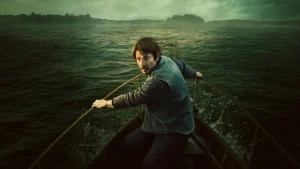
The finale is a logistics problem shot like a heist. Calvin rigs a net around the chunk of iceberg holding the egg sac and hauls it toward open water, which means his boat, the eggs, and a very large cephalopod share the same stretch of sea.
The camera stays low and wet, close enough that the hull groans against ice. There’s no triumphant score swelling under the tow. Just an engine working harder than it should and the black water giving nothing back.
Wade climbs aboard, and that’s the real turn. He’s been pulled between his father and Maggie for most of the runtime, and here he picks the deck of a leaking boat over the woman waiting on shore. When Walton lunges at Calvin, Wade puts himself in the way.
That’s the moment the film earns its reconciliation. Not a speech, not a hug on a dock. A son taking a hit for a father he’d stopped trusting.
Why The Iceberg Was Never A Hunting Ground
The reveal lands quietly. Fonda and Calvin work out that the iceberg is a nursery, and Mudder’s rampage retroactively becomes a mother standing between her young and a species that keeps showing up with nets and sonar.
Look back at the earlier attacks and the geometry changes. The creature wasn’t ranging across the harbor hunting. It was circling a fixed point, and that fixed point was the nest.
The film plants this in plain sight. Mudder’s behavior is defensive before it’s ever explained as such, and the military’s plan to blow the iceberg would have been a slaughter of unborn animals dressed up as a rescue. The horror was never the tentacles. It was the certainty of the men holding the detonators.
Who Walked Off The Water And Who Didn’t
Calvin survives, and the survival is the punishment. He gets his son back and watches a mother creature drift into warm water that will probably kill her brood anyway. That’s the bill.
Wade lives, but Maggie’s screams carry across the dark as the boat pulls away. He chose blood over love in a single afternoon, and the film doesn’t hand him a clean absolution for it.
Fonda stays standing as the film’s conscience, translating an ecological catastrophe into a sentence nobody wants to hear. The Crockers help evacuate and lose control of the narrative without ever being punished on screen.
Walton’s fate stays murky. Mudder isn’t killed, but Fonda’s line about the water temperature suggests the eggs won’t make it, and the mother may have spent her last reserves protecting them.
Blue Eye, Warm Water, And The Cold Truth Under The Surface
The final eye contact between Calvin and Mudder is the film’s whole thesis rendered in one shot. A blue eye the size of a dinner plate holds on a man who could have killed it, and neither of them moves first.
That’s a deliberate inversion of the creature-feature grammar audiences have absorbed for decades, and it sits comfortably alongside the more restrained monster work surfacing across recent theatrical releases that treat the animal as a character rather than a set piece.
The iceberg itself is the film’s best visual argument. It’s a habitat, a raft, and a coffin all at once, drifting through water that’s getting warmer every year. The new icebergs rising in the last shot aren’t a tease. They’re a diagnosis.
Are There More Mudders Out There?
The closing image of fresh icebergs breaking the surface has split viewers clean down the middle. One camp reads it as a sequel hook, a whole population of these creatures waking up as the climate shifts.
The other camp reads it as pure dread, with no franchise ambitions at all. The icebergs don’t need to contain monsters to be terrifying. They just need to keep coming.
The film never confirms whether the new floes carry egg sacs, and that ambiguity is doing real work. It’s the same restraint that keeps Walton’s fate unresolved and leaves the Crockers unpunished, resisting the tidy procedural conventions familiar from contemporary eco-thrillers that feel obligated to close every loop.
Saltwater, Silence, And A Door Left Open
There’s no post-credits stinger here. The last beat plays out on open water with Calvin and Wade watching new ice rise, and then the credits roll on that image alone.
That’s a self-contained ending with a cracked window. The immediate crisis is resolved, the town is spared, and the deeper problem is untouched. It’s the kind of finale that trusts the audience to sit in the discomfort rather than handing them a rescue.
Calvin’s boat idles in the dark with the engine still running. Somewhere behind him, Maggie is still screaming. The ice keeps coming up out of the water like it’s been waiting.
He saved the town and he saved the mother, and the babies will die of warm water regardless. That’s the toll the film extracts from a man who thought cutting a line was the same as winning.

Ankit Jaiswal is the Chief Author, covering Indian cinema and OTT releases with honest, no-filler criticism. An SEO strategist by background, he brings a research-driven approach to film writing, cutting through hype to tell you exactly what's worth your time.
Related Movies & Releases