Nayyi Navelli (2026): Yami Gautam Dhar’s Domestic Daayan Comedy Tests the Limits of Perfection

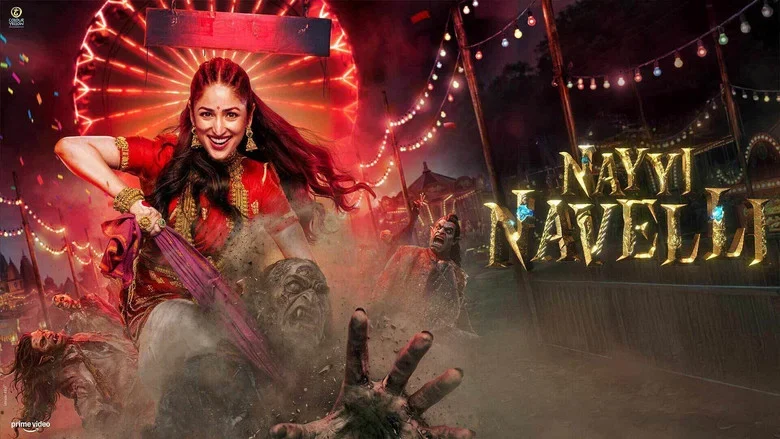
Balaji Mohan opens Nayyi Navelli not on a haunted threshold but on a kitchen floor, where a chaotic Meerut joint family discovers that order has arrived in the shape of a new bride. Yami Gautam Dhar plays Mohini, a woman so immaculate that her husband’s household begins to suspect the impossible: that domestic perfection might be a daayan’s disguise.
When A Perfect Bride Becomes A Family’s First Suspicion
The film’s central joke is deceptively simple. A household drowning in noise, mismatched expectations and generational friction suddenly finds harmony once Mohini takes charge of the kitchen, the schedules and the emotional weather of the family.
Himanshu Sharma and Divy Nidhi Sharma’s screenplay treats that improvement as both wish fulfilment and evidence. Every folded bedsheet and perfectly timed meal becomes a piece of circumstantial proof for the brother-in-law, who refuses to accept good fortune at face value.
That scepticism is where the comedy actually lives. The family wants to celebrate its luck; he wants to interrogate it, and the friction between gratitude and paranoia powers the first hour far more than any supernatural set piece.
The Foot Inspection Scene Turns Folk Belief Into Comic Investigation
The trailer’s most discussed beat arrives when the brother-in-law asks Mohini to show her feet, invoking the old belief that a witch’s footprint appears reversed. It is a clever piece of staging because the ritual is intimate, absurd and culturally specific all at once.
Rather than reaching for generic paranormal imagery, the film uses a household superstition as an investigative device. The camera stays close to the floor, the family gathers in awkward silence, and the scene’s tension comes from etiquette as much as from dread.
That choice distinguishes the film from the kinetic sensationalism that overtook Whalefall, which built its dread around isolation and physical extremity. Here the horror is social: a family forced to ask an impolite question of a woman they have just welcomed home.
Yami Gautam Dhar Plays Warmth As A Controlled Performance
Gautam Dhar’s work in the domestic passages is built on restraint. Mohini moves through the house with unhurried economy, her voice pitched low and pleasant, her hands always busy, and the performance asks the audience to read competence as concealment.
The role demands a sharp transition, and the trailer’s final reveal positions her as the film’s visual pivot. The shift from social domesticity into confrontation is where the actress carries the film’s tonal gamble, and the restraint she brings recalls the psychological weight of her turn in Doctor Who.
Supporting performers are largely asked to function as household texture rather than individual characters. Mita Vashisht’s Pinky Bua registers as a watchful presence in the family’s response to Mohini, though the material gives her little room to build a distinct comic register of her own.
Balaji Mohan Builds Suspicion Inside Ordinary Routines
The director’s structural instinct is to stage the supernatural inside the mundane. Harmony arrives first, suspicion second, and public transformation third, a three-beat reveal that keeps the audience ahead of the family without ever confirming the truth.
Just as he demonstrated tighter spatial discipline in Fire Country Season 5, Mohan strips away decorative camera moves here to prioritise domestic friction. The house itself becomes the pressure chamber, and the ensemble’s crowding around the dinner table does more narrative work than any exterior set piece.
What remains uncertain is whether that structure sustains itself across the full running time. The runtime is reported inconsistently, and a comedy that lives on escalating suspicion risks exhausting its central joke well before the reveal.
Amazon MGM and Colour Yellow Bet on the Family Fantasy Slot
Amazon MGM Studios and Colour Yellow Productions are positioning this as a theatrical family entertainer rather than a streaming curiosity, which places real financial weight on the October corridor. The banner’s recent slate has leaned on star-driven, mid-budget Hindi content, and this film’s ensemble structure spreads risk across familiar faces rather than a single marquee draw.
The commercial question is whether the daayan comedy can hold a family audience through a genre shift in its second half. That tonal pivot signals a broader appetite across contemporary hindi fantasys for stories that blend folk mythology with domestic comedy, a lane that remains commercially under-served.
The Uncomfortable Question Buried Under the Laughs
The film’s real subject is not whether Mohini is a daayan but why a family finds female competence so unnerving. Every skill she demonstrates becomes evidence against her, and the screenplay never quite lets the audience forget that suspicion is easier than gratitude.
Whether the final twist earns that idea depends on a resolution the marketing has deliberately withheld. If the reveal reframes the family’s paranoia as the true horror, the film will have something sharper than a punchline; if it settles for a conventional scare, the premise will remain a clever trailer in search of a third act.
Nayyi Navelli arrives with a genuinely novel comic engine and a lead performance built on controlled warmth. Its gamble is whether domestic perfection can sustain suspense for two hours, and that answer will be written in the ticket queues rather than the trailer.

Ankit Jaiswal is the Chief Author, covering Indian cinema and OTT releases with honest, no-filler criticism. An SEO strategist by background, he brings a research-driven approach to film writing, cutting through hype to tell you exactly what's worth your time.
Related Movies & Releases