Garividi Lakshmi (2026): Anandhi Carries a Folk Legacy the Film Doesn’t Earn

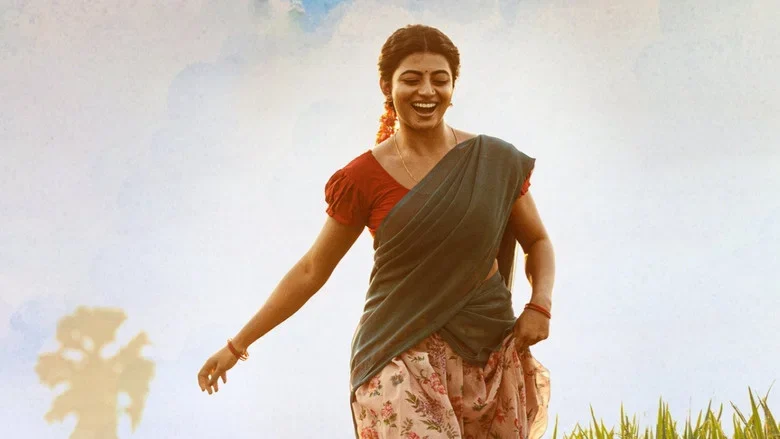
A woman steps into a Burra Katha circle where no woman is supposed to stand, and for a moment the frame belongs entirely to Anandhi. Then Gowri Naidu Jammu’s camera blinks, and the film rushes past its own most vital question.
Garividi Lakshmi arrives with the sincerity of a People Media Factory biography and the impatience of a production that trusts its subject more than its own storytelling. The result is a portrait painted in broad strokes where the grain of the wood demanded a finer brush.
A Folk Tradition Becomes a Weapon, and the Film Fumbles the Grip
The opening stretch traces Lakshmi’s childhood and artistic formation with the urgency of a man catching a train. Formative years that should anchor the entire emotional arc are compressed into montage, denying us the texture of how a girl becomes a voice.
Burra Katha, in this film’s most intelligent conception, is not decoration but dramatic action. Lakshmi’s performances function as public argument, folk rhythm bent toward challenging the patriarchal order that governs who gets to tell stories aloud.
That conceptual clarity is the film’s genuine achievement, and it echoes the cultural specificity that distinguished the sharper emotional architecture of Hushar Pittalu. Both films understand that regional drama lives or dies on the specificity of its soil.
When the Rise Is Told, Not Felt, the Disappearance Loses Its Weight
The second half introduces Lakshmi’s mysterious vanishing at the peak of her fame, a structural gamble that shifts the film from biography to retrospective investigation. It is a fine idea. It is also an idea the screenplay refuses to escalate.
Instead of tightening the mystery, the middle section loops through similar performance-and-conflict beats, each one slightly less urgent than the last. The disappearance should feel like a rupture. It lands like a plot point scheduled by committee.
Anandhi, to her credit, refuses to let the character flatten into a symbol. Watch her onstage: the chin lifted a fraction before a verse, the hands finding the rhythm of the dappu before the voice commits. These are choices, not accidents.
Her work here recalls the grounded, unshowy presence Naresh brought to Srinivasa Mangapuram, where performance carried material that the writing sometimes abandoned. Anandhi inherits that burden and mostly bears it.
The Supporting Ensemble Exists, and That Is Approximately All
Rag Mayur appears within the rise-and-disappearance architecture, but the screenplay never gives him a scene that requires him to do anything but react. He is a presence, not a pressure.
V.K. Naresh, a performer of considerable stillness, is similarly underused, drifting through the ensemble without a single confrontation that tests Lakshmi’s resolve. The film surrounds its protagonist with faces and calls it a world.
The antagonistic force, meanwhile, is patriarchy itself, which is dramatically defensible and dramatically difficult. Without a face to argue with, Lakshmi’s opposition remains atmospheric rather than embodied, and the conflict loses its teeth.
Charan Arjun’s Music and Aditya Javvadi’s Camera Do the Heavy Lifting
The performance sequences are where the film briefly justifies its existence. Charan Arjun’s compositions are staged as communal events, the camera holding wide enough to let us see the village listening, judging, and slowly shifting.
Aditya Javvadi’s framing favors the performer against the horizon, a choice that grants Lakshmi scale without turning her into a monument. It is the film’s most disciplined visual idea, and it works precisely because it repeats.
What the direction lacks is modulation. Gowri Naidu Jammu stages every emotional beat at the same register, so that triumph and loss arrive with identical volume. A folk drama needs silence to breathe between its songs, and this one rarely pauses.
Credit where due: the film’s commitment to North Andhra’s performance culture is genuine and uncondescending. It sits comfortably within a growing appetite for contemporary Telugu dramas that treat regional identity as a narrative engine rather than a marketing tag.
People Media Factory Bets on Cultural Prestige Over Commercial Muscle
People Media Factory, under T.G. Vishwa Prasad and Krithi Prasad, has built a slate around mid-budget prestige subjects, and this film fits that strategy precisely. The bet is on cultural currency rather than opening-weekend fireworks.
That is a defensible wager in a market where the biographical drama has become a reliable prestige lane. But the lane is crowded, and a film must deliver either a star turn of undeniable force or an emotional payoff that travels by word of mouth.
Anandhi’s theatrical leverage rests on exactly this kind of performance-led role, and she delivers enough to justify the casting. Whether that translates into sustained exhibition is a question the film’s own unevenness leaves uncomfortably open.
Set against the broader release calendar, including the seasonal churn of titles like Pokémon GO Halloween 2026, this is a film asking audiences to choose substance over spectacle. It mostly earns the ask, but not the margin.
The Ending Resolves the Mystery and Leaves the Woman Unresolved
Lakshmi’s disappearance is eventually reconstructed through retrospective investigation, and the film treats that reconstruction as closure. It is not. The woman who sang against the grain deserves more than an answer to where she went.
What lingers is not the resolution but the gap between the film’s ambition and its execution, between the folk artist it honors and the drama it fails to build around her. Anandhi’s performance survives that gap. The film does not.
Garividi Lakshmi is an honest attempt that mistakes coverage for depth, and its subject deserved a film that trusted silence as much as song. Watch it for the performances and the cultural specificity, and mourn the biography that got away.

Ankit Jaiswal is the Chief Author, covering Indian cinema and OTT releases with honest, no-filler criticism. An SEO strategist by background, he brings a research-driven approach to film writing, cutting through hype to tell you exactly what's worth your time.
Related Movies & Releases