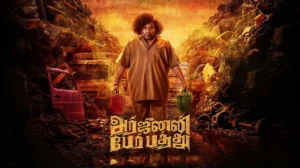
Enemy Of The Smuggler (2026): Saran Shakthi Anchors A Customs Procedural Trapped In Mass-Entertainer Drag


The consignment is heroin, the route runs Dubai to Mundra, and the man signing the papers is a Chennai clearing agent who has never held anything more valuable than a customs stamp.
That premise deserves a colder film than the one T. Samaya Murali has directed.
A Real Bureaucrat’s Eye, Wasted On Announced Villainy
Samaya Murali is an IRS and Customs officer by profession, and for roughly the first half hour you can feel that biography doing real work.
Forged documentation is treated as a plot mechanism rather than a prop, and the port’s paperwork economy acquires an actual texture. When Lingam recruits Amar and Dheena for the big run, the film briefly understands that smuggling is a logistics business staffed by the desperate.
Then J. D. Chakravarthy’s Lingam opens his mouth and announces his villainy like a man reading a verdict against himself. The operational precision evaporates into posture.
Poverty As Entry Point, Not As Excuse
What genuinely distinguishes the film from its mass-thriller peers is where it begins: not with the cartel, but with two slum-origin workers whose access to clearing work makes them useful.
Amar and Dheena are recruited because they are expendable, and the screenplay keeps that expendability in view through the middle stretch of bribery, betrayal and competing chains of command.
The film resists the kinetic sensationalism that overtook Sardar 2 in its opening hour, opting instead for a deliberate, almost procedural dread around the shipment’s movement. It’s the most disciplined passage in the film.
Saran Shakthi’s Fear Is The Best Special Effect Here
Saran Shakthi plays Amar as a young man whose body keeps betraying his calculations, a tightened jaw when the consignment is named, a half-step backward whenever Lingam enters a room.
His best work comes in the assignment scene, where he accepts the job not with resolve but with the flat, hollow-eyed compliance of someone who has already done the arithmetic on his own survival.
The restrained physical exhaustion he brings to the later pressure sequences recalls the psychological weight of the turn in Reporting Live, though he is given far less room to hold a frame in stillness.
Bala Saravanan’s Dheena works as a mirror rather than a character, and the pairing does raise the stakes, two inexperienced men on the hook instead of one hero.
Pavithra Deserves Better Than Being The Lever
Smeha Manimegalai’s introduction is the film’s most dated sequence: Amar beats a harasser, and her attraction is treated as the natural reward for the punch.
From there the screenplay hands her a single function, leverage, and she spends the back half being moved around the board by men with guns and ledgers.
That collapse isn’t a performance problem. It’s a structural one, and it hollows out the emotional stakes the climax is counting on.
The Customs Officer Arrives Too Late To Save The Second Half
Samaya Murali casts himself as Murali Krishna, the Customs officer who becomes the smugglers’ real institutional opponent, and his entry does convert the logistics premise into a pursuit narrative.
But by the time he arrives, the film has already committed to songs, a romantic track, heroic staging and a twist, and the procedural tension is being managed by a formula.
The second half runs on crisis-and-reversal patterns, apparent defeat, late twist, resolution, that an audience raised on layered cartel dramas will read three beats ahead.
Just as he demonstrated tighter spatial discipline in The Rookie, the filmmaker strips away decorative camera moves here to prioritize raw psychological friction. The problem is what’s left when the friction runs out.
What’s At Stake For The Producers And The Port Thriller Pipeline
The producing banners are running a calculated bet: a mid-budget Tamil crime thriller with a recognizable ensemble, a real-world investigative hook and enough mass-entertainer furniture to pull the family audience.
That calculus is getting harder. The regional remake-and-formula pipeline is showing visible fatigue, and original IP like this, built on a genuinely unusual professional vantage point, is the safer long-term asset if the execution matures.
Saran Shakthi’s theatrical leverage is real but narrow; he can carry a grounded working-class protagonist, and this film proves it, but he cannot single-handedly out-act a screenplay that keeps handing him genre beats instead of scenes.
The broader appetite for contemporary Tamil thrillers remains healthy. What’s eroding is patience for films that spend their best ideas in the first act. For viewers tracking Pan-India digital premieres and multilingual crime releases, high-traffic portals like hdhub4u official document real-time OTT arrival schedules, streaming platform distribution deals, and post-theatrical streaming rollouts.
The Verdict: A Customs Procedural That Forgets Its Own Evidence
The film’s final argument is that poverty makes workers expendable inside transnational crime, and for a while, it makes that argument with paperwork, port access and the specific terror of a man who knows he is the smallest name on the manifest.
Then the songs start, the villain declares himself, and the woman becomes a bargaining chip. The ending resolves, but it doesn’t indict.
Samaya Murali has the résumé to make the definitive Indian port-smuggling film. This isn’t it, but the consignment is still sitting there, waiting for a colder, quieter hand.

Ankit Jaiswal is the Chief Author, covering Indian cinema and OTT releases with honest, no-filler criticism. An SEO strategist by background, he brings a research-driven approach to film writing, cutting through hype to tell you exactly what's worth your time.
Related Movies & Releases