Meethe Mein Kya Hai (2026): Ritwik Bhowmik Anchors a Diwali Grief Drama That Mistakes Crowds for Conflict

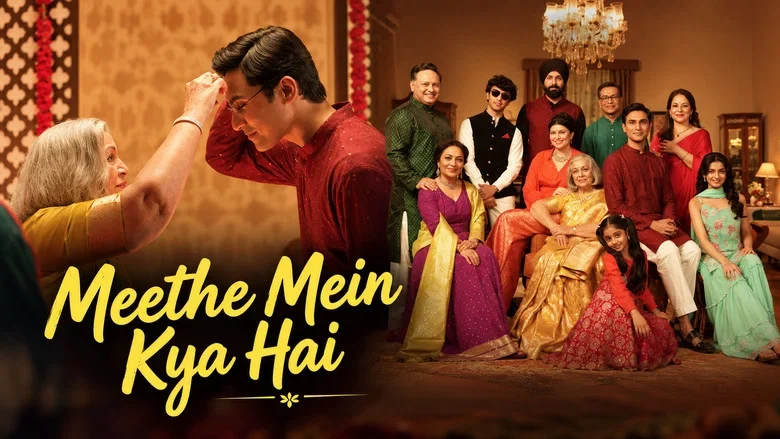
The first thing Radhika Bansal’s camera finds in Lucknow is not a face but a doorway, a frame so cluttered with marigold garlands and cousins that you feel the draught before anyone speaks.
Jai has come home for Diwali carrying a widow’s silence into a house that has no room for it. That collision is the entire film.
A Widower Walks Into a Festival and the Festival Wins
Bansal’s debut has an instinct worth respecting: it treats the joint family as a physical organism, not a backdrop. Bodies occupy corridors. Aunts conduct surveillance from kitchen thresholds.
Ritwik Bhowmik plays Jai with his shoulders permanently braced, as though the house might embrace him to death. Watch how he accepts a plate of food, both hands, no eye contact, retreating before the second helping arrives.
It is a performance built on retreat rather than display, and for a while that restraint is the film’s sharpest instrument. Then the surprise marriage announcement detonates and the screenplay hands him a house full of people who all talk at once.
Where the Domestic Comedy Turns Into a Noise Complaint
The film’s core mechanism is generational friction: elders who confuse obedience with affection, a younger set who mistake announcement for autonomy. That is fertile ground, and the first hour works it honestly.
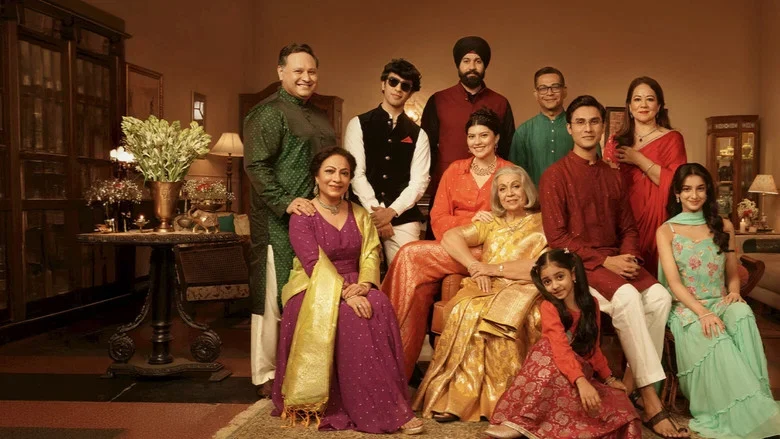
But the writing begins to substitute volume for escalation. Every disagreement is staged at the same pitch, in the same courtyard, with the same overlapping cross-talk, until the family stops feeling like a pressure chamber and starts feeling like a party you cannot leave.
Compare the discipline on display in Prahaar, where a single room and a fixed set of rules generate unbearable friction. Bansal has the room. She lacks the rules.
Rohini Hattangadi Holds the House Together With a Teacup
Rohini Hattangadi’s Nani is the film’s gravitational centre, and she works almost entirely through stillness, a hand resting on a table edge, a glance that ends an argument before it starts. When she finally raises her voice, the room earns its silence.
Ayesha Raza’s Amrita is handed the film’s most thankless labour: absorbing other people’s grief while her own goes unexamined. She plays the swallowed objection well, but the script never lets her finish the sentence.
The ensemble texture is rich and largely anonymous. Cousins drift through the frame, deliver a laugh line, and vanish; the film mistakes their presence for characterisation.
Bhowmik’s Grief Is Real, His Arc Is Rushed
There is a stretch in the second hour where Bhowmik sits alone on a terrace while the celebration continues below, and the film briefly becomes the thing it promised to be. His face does nothing dramatic. That is precisely the point.
The recovery arc, however, arrives on schedule rather than on instinct. The rapprochement in Reporting Live demonstrated how procedural exhaustion can be made to feel earned through accumulated physical detail; here the thaw is announced by a hug and a musical cue.
By the closing scenes, Jai’s grief has been processed by the plot rather than by the character. The film wants to be about the slow, unglamorous work of re-entering a family. It settles for the montage.
Diwali as Lighting Design, Not as Meaning
The visual scheme leans hard on the festival: string lights in the foreground, diyas on every sill, a warm amber wash that flattens the frame into postcard consistency. It is pretty. It is also undifferentiated.
Bansal’s camera keeps its distance during the arguments, cutting between faces at the same medium range until the geography of the house dissolves. A film about a family that cannot hear each other should place us inside the overlap, not outside it.
The score does the emotional accounting the screenplay declines to do, swelling precisely where a scene has failed to build its own case. Silence would have been braver.
The Streaming Calculus Behind a Festival Family Drama
This is a Netflix acquisition, and it shows in the film’s risk profile, a contained single-location ensemble piece with a recognisable streaming lead and a holiday-release hook. The economics of that bet are sound.
What remains unresolved is the commercial identity of the Hindi family drama in the streaming era, where the theatrical event film has absorbed the box-office oxygen and the domestic ensemble piece has been quietly rerouted to the platform queue.
For Bhowmik, this is a useful consolidation of a leading-man profile built on restraint rather than charisma. For a first-time director, it is a calling card with one clear virtue: she trusts actors. The next step is trusting the audience with less.
What the Ending Refuses to Say Out Loud
The film resolves its marriage dispute and its grief in the same gesture, which is generous and slightly evasive. The family secrets that surfaced mid-film are absorbed back into the household without consequence.
That may be the honest truth about families, grievances swallowed, plates passed, another festival next year. But a film that spends two hours exposing the cost of that silence should not then participate in it.
Streaming has given Hindi family dramas a quieter home and a smaller argument, as the widening landscape of contemporary hindi dramas keeps demonstrating. Bansal has the eye and the cast. What she needs is a screenplay willing to let the sweet turn sour before it turns kind.
Meethe Mein Kya Hai asks its title question and answers it with a house full of people and one empty chair. The chair is the film. Everything else is decoration.

Ankit Jaiswal is the Chief Author, covering Indian cinema and OTT releases with honest, no-filler criticism. An SEO strategist by background, he brings a research-driven approach to film writing, cutting through hype to tell you exactly what's worth your time.
Related Movies & Releases