Carrie (2026) Ending Explained: Emaline’s Shadow & Who Kills Margaret

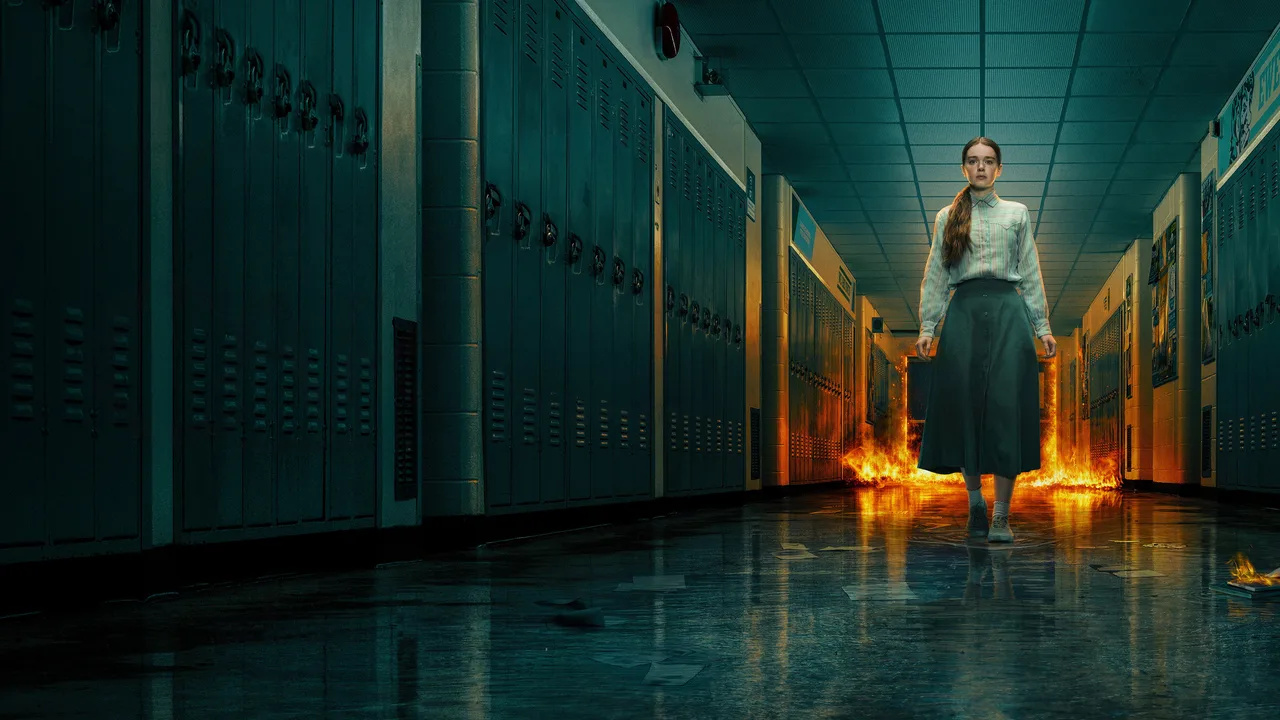
The car engine turns over in the gray morning light, and Carrie White is in the passenger seat with a fresh stab wound and a town’s worth of rubble behind her. Emaline is behind the wheel, promising safety, promising distance from Chamberlain. The series cuts to black on that promise, and the horror isn’t the destruction we just watched. It’s how calm the two of them look leaving it.
Prime Video’s eight-episode reimagining pushes Stephen King’s prom-night tragedy into something far stranger and more unsettling. The finale detonates the familiar story and rebuilds it around a girl who may be talking to a ghost, a projection, or nothing at all. Here’s what the last hour actually leaves on the table.
From Viral Humiliation To A Town Reduced To Rubble
The pressure cooker this time isn’t a single bucket of pig blood. It’s a phone screen. Carrie enters public high school after her father’s death, raised in near-total isolation by Margaret, and the bullying that finds her is filmed, clipped, and shared before she can even process the shame. The cruelty has an audience now, and that audience never stops watching.
What the finale understands is that humiliation at scale doesn’t just wound a teenager. It rewires her. Carrie’s telekinesis surfaces alongside her social media notoriety, and the show treats the two as connected pressure systems, the more the town stares, the harder the psychic lid presses down. By the time the last episode opens, the question isn’t whether Carrie will break. It’s how far the blast radius reaches.
That escalation from a contained school tragedy to a community-wide reckoning reflects a broader appetite for slow-burn supernatural horror across recent streaming releases, where the monster and the metaphor share the same skin.
When A Dance Through A Dying Town Becomes The Real Massacre
The centerpiece of the finale is not a gymnasium. It’s a promenade. Carrie and Emaline move through Chamberlain’s streets as the town comes apart around them (glass, fire, collapsing structures) and the two of them are dancing. The camera stays close on their faces while the destruction happens at the edges of frame, which is the cruelest possible choice. We’re made to watch joy while a town dies.
This is where the show’s craft sharpens. The destruction isn’t staged as spectacle for its own sake. It’s staged as intimacy. Carrie finally has someone to hold onto, and the world that tormented her is being erased in the same motion. The choreography of two girls swaying through chaos lands harder than any exploding building could.
Then a gunshot. Emaline is hit, and she simply vanishes. No body, no blood pool to confirm the worst, just absence. The series refuses to let the violence resolve into a clean death, and that refusal is the hinge the entire ending swings on.
The Girl Nobody Else Can See
Here’s the reveal that reframes every scene that came before it. Emaline is an astral projector, she began visiting Carrie after Carrie’s powers first surfaced. Carrie can see her, touch her, dance with her. Everyone else sees a traumatized girl talking to empty air.
The breadcrumb was planted early and quietly. When Adelaide interrogates Sue Snell and probes her memories, Sue describes a shadow behind Carrie. That single detail is the show winking at us. Emaline was always there, present in the frame even when the other characters couldn’t perceive her. On a rewatch, every scene of Carrie seemingly alone in a hallway or a bedroom carries a second body we simply weren’t allowed to see.
The show handles this ambiguity with the restraint that distinguishes the better entries in contemporary supernatural thrillers, never over-explaining whether Emaline is a projection, a spirit, or a manifestation of Carrie’s own fractured mind. The uncertainty is the point.
Who Walked Out And Who Paid The Toll
Carrie survives. Margaret stabs her, and the wound isn’t fatal, a reversal that flips the original story’s most famous image on its head. In King’s version, the mother’s blade is the end. Here it’s just another injury Carrie absorbs before she levels her own house and collapses into unconsciousness. She leaves Chamberlain wounded, alive, and carrying the weight of everything she just did.
Margaret doesn’t get a redemption arc or a final embrace. Adelaide and Caitlin corner her, with Caitlin reading her mind while Adelaide runs the interrogation, and then Adelaide kills her. The matriarch who dominated every version of this story is removed not by her daughter’s rage but by an outside investigator. It’s a colder, more clinical death than the myth demanded.
Emaline’s fate is the show’s deliberate open wound. Shot, vanished, then reappearing in the driver’s seat the next morning. Whether she survived physically, projected herself back into Carrie’s perception, or exists as something the series will never fully name: that’s left hanging. Sue Snell survives as the witness who saw the shadow. Adelaide and Caitlin walk away with their investigation unresolved. The town itself is the real casualty, and the show pointedly refuses to hand us a body count.
The House That Had To Fall
Carrie doesn’t just destroy Chamberlain. She destroys her own home, and the sequencing matters. The house comes down after the town, after Margaret’s death, after the stabbing. It’s the last thing standing between Carrie and whatever comes next, and she takes it apart herself.
Margaret’s death reverses the family power structure entirely. The mother who controlled every inch of Carrie’s world is killed by a stranger, and Carrie outlives her. But the show is careful not to call that liberation. Carrie walks away with a knife wound and a body count, and the visual language of that final car ride (flat morning light, an empty road, no triumph in her face) suggests escape and consequence are the same thing here.
The deeper unease sits in Emaline herself. Carrie’s first real connection is inseparable from her unstable psychic world. Leaving with Emaline could be freedom from abuse. It could also be retreat into a reality that isn’t fully real. The show lets both readings stand.
Is Emaline Real, Dead, Or Something Else Entirely
The finale’s biggest unresolved argument is whether Emaline survived the gunshot at all. One camp reads the car as proof of life, she’s driving, she’s talking, she’s taking Carrie to safety. The astral projection mechanic supports a second reading: Emaline’s body may be gone, but her projected form persists because Carrie’s perception keeps her present.
A third theory circulating among viewers is darker. Emaline never existed as a separate person, and the “shadow” Sue saw was Carrie’s own power externalizing a companion she desperately needed. The show plants evidence for all three and commits to none, which is either frustrating or the smartest thing it does.
The Adelaide and Caitlin thread is the other loose end. Two investigators with mind-reading capabilities and an unresolved interest in Carrie’s abilities are still standing when the credits roll. That’s not an accident.
An Open Road And No Clean Answers
The series doesn’t confirm a post-credits scene, and it doesn’t need one. The final image of Carrie in Emaline’s passenger seat is the thesis statement. She’s alive, she’s wounded, she’s leaving, and she’s not remotely free.
What the ending sets up is a second season built on questions the first one refused to answer. Where does Carrie go? What happens to a girl who flattened a town when the legal and supernatural consequences catch up? Does Emaline’s projection hold, or does it fade the further they drive from Chamberlain?
Carrie White ends this story the way she began it, isolated, dependent on a connection no one else can verify, and carrying power she never asked for. The car pulls away from the wreckage, and the show lets the silence do the talking.

Ankit Jaiswal is the Chief Author, covering Indian cinema and OTT releases with honest, no-filler criticism. An SEO strategist by background, he brings a research-driven approach to film writing, cutting through hype to tell you exactly what's worth your time.
Related Movies & Releases