Interstellar Ending Explained: The Tesseract Twist & Why Cooper Leaves Murph

The second hand of a cheap wristwatch ticks out a message from the far side of a black hole, and an old woman in a hospital bed finally understands that the ghost who haunted her childhood was her own father begging her not to let him go. That is where Christopher Nolan cuts the emotional fuse of Interstellar: not on a battlefield, but on a small piece of jewelry passing quantum data through Morse code. By the time Cooper floats, half-frozen, in the cold light near Saturn, the film has already detonated its real payload. He saved humanity. He lost his daughter’s entire life to do it.
Five Dimensions, One Bedroom, and a Mission Bleeding Fuel
The third act is a machine built out of bad math and worse men. Professor Brand dies confessing that Plan A was a lie, the gravity equation was never solvable from the outside, so Earth’s population was always a corpse waiting to happen. Dr. Mann, meanwhile, has been broadcasting fabricated data from an ice world that would kill anyone who stayed. Both men are liars, but only one of them lies to save a species and the other lies to save his own skin.
What’s left is a crippled Endurance, a dwindling fuel reserve, and a slingshot maneuver around Gargantua that requires shedding mass. Someone has to fall. Nolan stages this not as a heroic vote but as a quiet theft, Cooper prepping his Ranger while Brand runs the numbers, refusing to let her be the one who dies. The pressure here is entirely mechanical. Docking clamps, rotation speeds, fuel readouts. The film trusts physics to do the emotional work, and it does, in stark contrast to the looser spectacle of something like Beyond Ratings.
Docking With a Spinning Wreck While Mann’s Hatch Blows Open
Mann’s death is the ugliest beat in the film and the most instructive. He overrides the docking procedure and pops his hatch against a rotating station, and the pressure differential rips the airlock apart. The explosion doesn’t just kill him, it turns the Endurance into a tumbling, unrecoverable mass. Nolan shoots the rupture in hard cuts, then hands the sequence to Cooper’s cockpit, where the camera locks to the window as he matches the station’s spin. No music swell. Just the grind of metal and Cooper’s breathing.
That manual dock is the last pure act of piloting in the movie, and it’s the moment the film earns its later abstraction. Cooper isn’t a chosen one here. He’s a guy who knows the rotation math and has nothing left to lose. The visual grammar (tight interiors, the black void pressing against the glass) recalls the procedural discipline Nolan brought to The Odyssey, where craft and dread share the same frame.
Why Cooper Is the Ghost and the Watch Was Always the Antenna
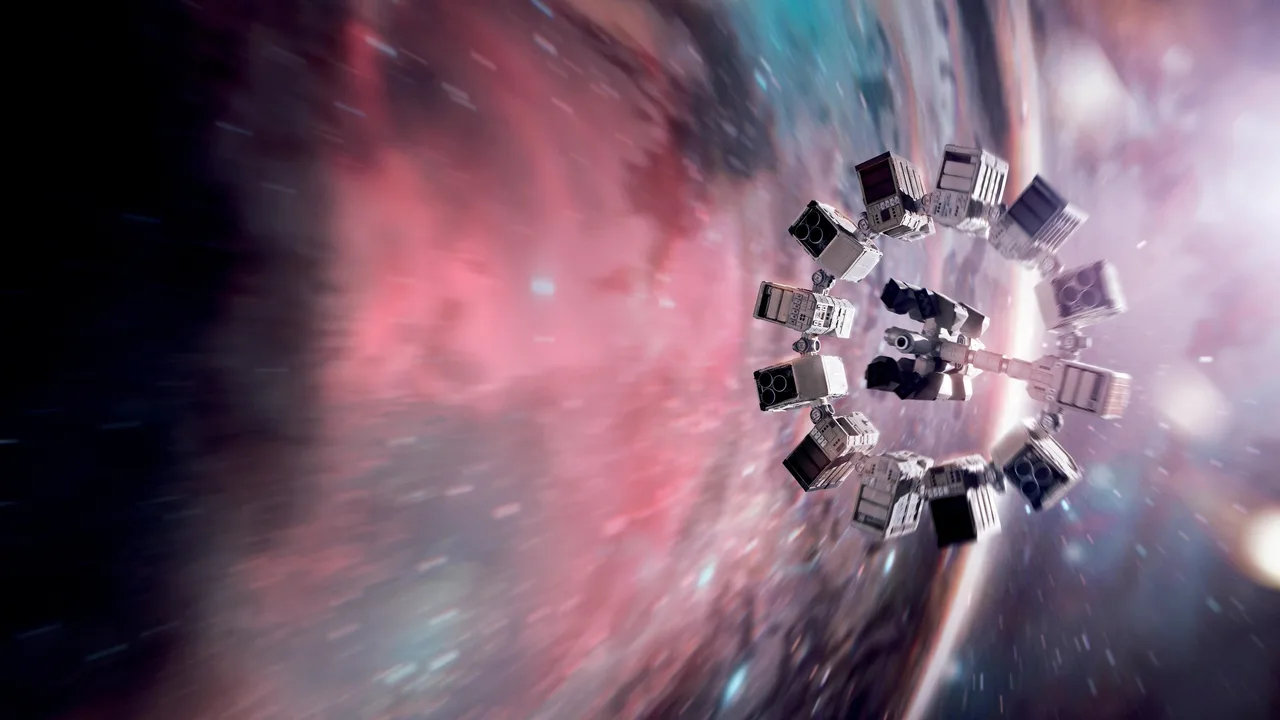
Crossing the event horizon, Cooper doesn’t get spaghettified. He gets filed. The tesseract is a lattice of Murph’s bedroom at every age, a bookshelf corridor stretching into infinity, and Cooper’s first instinct is to smash through the wall and grab her. He can’t. The revelation lands physically before it lands intellectually, his hands pass through furniture, his voice doesn’t carry, and then he sees the books fall and the dust settle into coordinates. He’s been haunting her since before he left.
The watch is the film’s cleanest piece of screenwriting machinery. It’s introduced early as a sentimental gift, dismissed as a trinket, and then repurposed as a gravitational transmitter. Cooper pushes Morse pulses through the second hand, and adult Murph, played with steel and grief by Jessica Chastain, recognizes the irregularity as intent. The causal loop closes with a click. Everything Cooper did to reach this moment was set in motion by the message he’s only now sending.
Who Survived Gargantua and Who Paid the Toll in Blood and Years
Cooper lives, but the film charges him compound interest. He wakes on Cooper Station biologically middle-aged while his daughter is dying of old age, and the reunion is shot in a sterile hospital room where the camera keeps its distance. Murph doesn’t beg him to stay. She tells him a parent shouldn’t have to watch a child die, and she sends him away. It’s the cruelest kindness in the movie, and it reframes his entire sacrifice as something she had to finish for him.
Brand gets the loneliest ending. She reaches Edmunds’ planet to find him dead, and she buries him alone with CASE and a cache of embryos, beginning a colony that will take generations to mean anything. Mann and Romilly are simply gone, one to his own cowardice, one to a bomb triggered by it. The moral ledger is brutal and unsentimental. The liars die badly. The survivors inherit work, not peace.
Love, Gravity, and the Cold Geometry of the Final Frame
Nolan never quite claims love is a force. He claims it’s a compass. Brand’s speech about love transcending time gets dismissed by Cooper in the moment, but the tesseract proves her half-right, Cooper finds Murph’s timeline not through physics alone but because he knows exactly which bedroom to reach for. The film’s visual language does the rest. Earth is brown and dust-choked. The station is clean white curves. Edmunds’ planet is a wash of blue and sunlight, the first warm frame in two hours.
Gravity is the only thing that crosses the dimensional boundary, and Nolan makes that literal in every frame of the tesseract, light bending, dust drifting, the watch hand twitching. The sound design drops to near silence inside the structure, then floods back with Hans Zimmer’s organ when the data transmits. It’s a rare case where the film’s biggest idea and its smallest object are the same thing.
The Bulk Beings Debate and the Loop Nobody Can Fully Untie
The film leaves its architects unnamed. The bulk beings who built the wormhole and the tesseract are strongly implied to be future humans who evolved past three dimensions, but Nolan never confirms it on screen. One camp argues the loop is closed and stable, Cooper’s message always existed, humanity always survived, and the “ghost” was never supernatural. The other camp insists the film cheats, that a bootstrap paradox can’t generate its own cause, and that the tesseract is a narrative convenience dressed in physics.
Both readings hold water, and the ambiguity is deliberate. What’s not ambiguous is the film’s refusal to explain the bulk beings’ motives beyond survival. They reached back because they had to. The same logic drives Cooper through the wormhole and back out again.
Saturn’s Light and the Man Flying Toward a Grave He’ll Never See
There’s no post-credits stinger, no franchise scaffolding. The final image is Brand alone on Edmunds’ planet, helmet off, breathing alien air, and then Cooper’s Ranger cutting through space toward her. It’s a hopeful ending that quietly admits its own tragedy, by the time Cooper arrives, decades will have passed for Brand too. The film ends on motion, not resolution, and that’s the point. The broader landscape of contemporary cinema rarely trusts audiences with an ending this open, and Nolan earns it by keeping the final beat physical: a ship, a destination, a woman waiting.
Cooper doesn’t get his daughter back. He gets a direction. He straps into a cockpit and flies toward a woman he barely knows because the alternative is sitting in a station built on his own sacrifice, watching the clock run out on everyone he loved. The watch is gone. The message is delivered. All that’s left is the burn of the engines and the long silence between stars.

Ankit Jaiswal is the Chief Author, covering Indian cinema and OTT releases with honest, no-filler criticism. An SEO strategist by background, he brings a research-driven approach to film writing, cutting through hype to tell you exactly what's worth your time.
Related Movies & Releases