My Dear Stranger (2026): Wang Luodan Anchors a Dual-Case Mystery That Trusts Its Own Silence

The rain hasn’t stopped for four years. That is the first thing the show tells us without saying it, a police captain standing over a case file with a photograph he keeps turning face-down, and somewhere in the same city, a woman who has been rehearsing her own disappearance since before we met her. My Dear Stranger opens not with a body but with a filing cabinet, and the choice is deliberate. This is a mystery that believes the paperwork is the psychology.
Lin Yu-Hsien’s thirteen-episode series has the patience of a director who has stopped trying to impress anyone. Where a lesser production would cut to the crime, he cuts to the aftermath, the fluorescent hum of a station at 2 a.m., the specific exhaustion of a man who has been wrong before. It recalls the spatial discipline he brought to Toxic, where the camera refused to flatter its own violence. The difference here is that the restraint is no longer a stylistic choice. It is the entire argument.
A Witness Who Refuses To Be A Victim
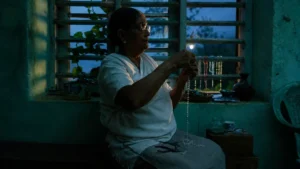
Wang Luodan plays Yu Xiao as a woman who has learned that being watched is a kind of employment. In the first two episodes she gives almost nothing away, a flat vocal register, hands that stay folded, a gaze that lands just past whoever is speaking to her. It is a performance built on withholding, and it works because the show never punishes her for it.
The structural gamble is that Yu Xiao is not a suspect and not a victim. She is a witness who becomes an investigator, and the shift happens so gradually that you almost miss the moment the show changes hands. Song Cheng, the police captain, doesn’t recruit her out of generosity. He recruits her because she is the only person who has been living inside this crime since before it had a name. That is a smarter engine than most procedurals bother to build.
Two Crimes, One Wound, No Shortcuts
The present-day investigation keeps reaching back to an unsolved case from four years earlier, and the show resists the temptation to make that connection feel like a revelation. It is not a twist. It is a diagnosis. The two timelines don’t intercut for suspense; they intercut because the same person is standing in both of them, and the show wants you to feel the weight of that continuity rather than the thrill of the reveal.
What makes this work is that Yu Xiao’s hidden past functions as both character history and evidence. The show never separates the two. When a detail about her emerges, it changes what the case means, not just what we know. That is a harder trick than it sounds, and Lin Yu-Hsien pulls it off by refusing to underline the moment. The camera stays still. The score drops out. The information lands in silence, which is where it belongs.
The Stillness That Manufactures Pressure
Yuan Hong’s Song Cheng is the show’s most interesting miscalculation. He is written as a persistent, observant captain, and Yuan plays him with a quiet, almost bureaucratic steadiness that occasionally flattens scenes that need a pulse. In the interrogation sequences, he sits across from Yu Xiao with his hands flat on the table, and the show asks us to read his patience as strategy. Sometimes it is. Sometimes it just looks like a man waiting for the scene to end.
The supporting cast is largely functional. Bosco Wong Chung-Chak appears as Zhu He with a coiled, watchful energy that suggests a character the show never quite commits to exploring. Jiang Xin and Lin Peng are credited in roles that the series treats as connective tissue rather than dramatic engines, present, competent, and almost entirely without interiority. That is not a flaw of performance. It is a flaw of allocation.
When The Investigation Becomes The Relationship
The middle stretch of the season is where the show finds its real subject. Yu Xiao and Song Cheng stop being witness and officer and start being two people who have each been shaped by the same unresolved event. The show doesn’t romanticize this. It doesn’t even particularly dramatize it. It just lets the proximity do the work, shared silences in cars, the specific intimacy of two people reading the same file.
This is where the comparison to DOJ Antitrust Probe Hits becomes unexpectedly useful. Both productions understand that institutional pressure is most legible in the faces of people who have stopped explaining themselves. The difference is that this show trusts its audience to sit in that opacity rather than narrating it.
The Ending Doesn’t Resolve. It Reclassifies.
Without spoiling the final reveal, the last two episodes reframe the entire investigation as an act of delayed recognition. The culprit is identified, justice is nominally served, and yet the show’s final image is not of resolution but of two people standing in a room they have been circling for thirteen hours. The crime is solved. The wound is not.
That refusal to close the emotional loop is what separates this from the more conventional Romanchakam, which treated its own messiness as a feature rather than a consequence. Here, the mess is the point. The show doesn’t want you to feel satisfied. It wants you to feel the specific discomfort of understanding something too late.
The Verdict
My Dear Stranger is a thirteen-episode mystery that trusts silence more than it trusts plot, and mostly earns that trust. Wang Luodan’s performance is the anchor, a study in withheld information that never tips into opacity for its own sake. The dual-case structure is genuinely well-engineered, even if the supporting cast is left stranded by a script that forgets to give them interior lives.
What lingers is not the reveal. It is the image of two people who have been living inside the same unresolved event for four years, finally standing in the same room, and still not quite able to say what it cost them. That is a more honest ending than most shows of this genre are willing to attempt.
Rating: 3.5 / 5
Some mysteries are solved. This one just stops being hidden.

Ankit Jaiswal is the Chief Author, covering Indian cinema and OTT releases with honest, no-filler criticism. An SEO strategist by background, he brings a research-driven approach to film writing, cutting through hype to tell you exactly what's worth your time.
Related Movies & Releases