Newton’s 3rd Law (2026): Sumanth Anchors A Slow-Burn Telugu Thriller With Uneven Payoff

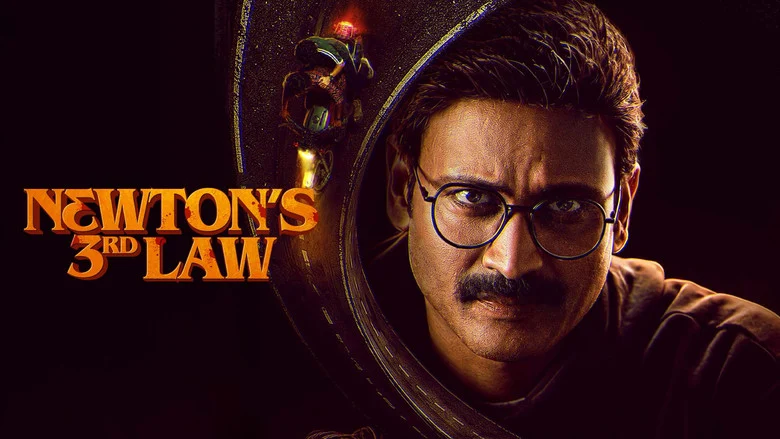
Sumanth steps into the cop role with a restrained physicality that suits the film’s investigative core. His Vasudev isn’t a shouting, chest-thumping officer, he’s a man reading files, connecting dots, and carrying the weight of two decades of buried secrets.
Watch him in the post-mortem scene where the bullet is pulled from Vinay’s head. The case flips from accident to murder, and Sumanth registers the shift with a subtle hardening of his eyes. It’s the kind of performance that makes a modest thriller watchable, and reviews consistently credit him as the film’s anchor.
Rajesh Karna’s Framing Device Shows Ambition, But Loses Grip
The 2026 framing scene with Srinivas Avasarala’s David reading Newton’s 3rd Law Part 1 is a clever structural idea. Karna wants to build a mystery where every action triggers a delayed reaction, and the non-linear jump back to 1999 sets up that promise well.
But the screenplay loosens its hold in the middle. Crucial scenes are handled in an ordinary way, and the thriller rhythm falters exactly where it needs to tighten. Karna keeps the film free of melodrama, yet the cost is a flatness that reduces suspense.

The Genre Core: A Thriller That Leans on Reveals, Not Set Pieces
Filmy Focus rates this 2.5/5, calling it “a largely satisfying minimalistic crime thriller.” That minimalism is both the film’s identity and its limitation. There are no chase sequences or gun battles, just clue gathering, interviews, and the slow assembly of a hidden pattern linking deaths from 1999.
The bullet discovery is the genre pivot, sharply reorienting the narrative into a murder inquiry. It’s a strong beat, and the film knows it. The problem is what comes after: the middle section stretches thin, and the tension that should compound with each reveal instead dissipates into routine investigation scenes.
What saves the film is its compact storytelling. At 2h 18m, it never bloats into self-importance. The climax delivers a decent payoff, and several reviews note that the final act improves on the sluggish middle. One critic summarised it as “an average thriller that features good performances from Trinadh Varma and Sumanth, along with a few good twists and a decent climax.”
Trinadh Varma and the Supporting Cast’s Quiet Contribution
Trinadh Varma earns specific praise in a cast that doesn’t get many standout moments. His presence helps the twist-heavy structure land, and he makes the most of limited screen time by grounding his scenes in believable tension.
Jagapathi Babu is listed among the main cast, though his role doesn’t generate consistent critical commentary. His casting signals the film’s serious intent, a veteran presence that lends weight to the procedural drama. Srinivas Avasarala, as David alias Kishore, bridges the 2026 framing and the 1999 past, and his scenes carry the film’s philosophical thread about consequence and reaction.
Neha Pathan’s Jyothi appears in the 1999 setup, and her death after learning of her husband’s demise establishes the emotional stakes early. It’s a brief role, but it grounds the mystery in human loss rather than pure puzzle-solving.
The Box Office Reality and Audience Verdict
The numbers tell a sobering story. Sacnilk reported a first-week India net of ₹1.30 crore and worldwide gross of ₹1.47 crore, with an opening day of just ₹0.13 crore. The trade verdict is a flop, and the modest collections reflect a film that couldn’t convert its critical strengths into commercial momentum.
Audience complaints mirror the critics: a slow screenplay, ordinary treatment of key scenes, and insufficient suspense for a thriller. The praise is equally consistent, Sumanth’s lead performance, the 1999 mystery setup, and the climax twists. This is a film for viewers who prefer low-key, investigation-driven Telugu dramas. If you need fast-paced commercial thrills, this isn’t your film. But if you’re willing to sit with a slow-burn mystery and watch Sumanth work, there’s something here worth your evening. Best watched on OTT where the pacing feels less punishing.
Browse more Telugu Thriller reviews for similar investigation-led dramas.
Newton’s 3rd Law is a decent one-time watch for Sumanth fans and patient mystery lovers, though it never rises above its modest ambitions, I’d rate it a fair 2.5/5.
For a more tightly wound mystery with a similar investigative core, Abeyance review offers a sharper execution of the genre’s potential.
If you prefer uneven thrillers with strong central performances, Unmadham verdict shares this film’s strengths and weaknesses.

Ankit Jaiswal is the Chief Author, covering Indian cinema and OTT releases with honest, no-filler criticism. An SEO strategist by background, he brings a research-driven approach to film writing, cutting through hype to tell you exactly what's worth your time.
Related Movies & Releases