Ananthan Kaadu (2026): A Karmic Thriller That Risks Losing Its Grip on the Past

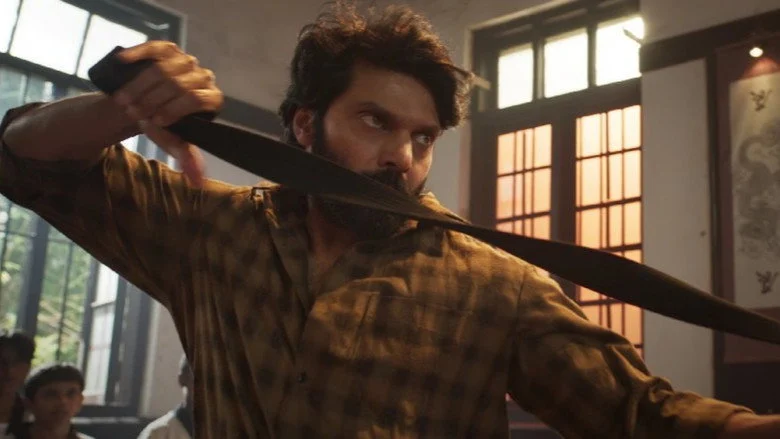
The opening frames of Ananthan Kaadu, set in the sooty corridors of Thiruvananthapuram during the 1980s–1990s, don’t just establish a place, they announce a fatalist thesis: every ambition carries a receipt, and karma always collects. It’s a risky gambit, pinning an entire action-thriller on a philosophical spine rather than a conventional plot engine, and for a while, director Jiyen Krishnakumar and writer Murali Gopy make it work with atmospheric grit and Arya’s coiled intensity, until the narrative starts to wander in search of a clear antagonist worth the wait.
Arya Lets His Brooding Do the Heavy Lifting, Until It Doesn’t
Arya, playing a man defined by his desperation and drive, uses his physical stillness to suggest a reservoir of violence in the early reels, especially in the clinching moment where he first sets those “powerful forces” in motion. But as the film slides into Act 2’s moral confusion, his performance narrows into pained brooding, relying on the karmic concept to explain every dropped thread.
I wanted one scene where his character’s ambition felt specific, not just archetypal, the opening socio-political texture promises a man of his time, but Arya’s arc remains frustratingly generic past the first hour.
Krishnakumar and Gopy: A Sharp World but a Blunt Script
Jiyen Krishnakumar’s direction excels in painting the universe, the moth-eaten bylane politics, the parched daylight of the 1990s, the slow-turning wheels of local power. It’s an assured visual first feature.
The screenplay, however, stumbles over its own thesis: Murali Gopy’s plotting is linear to a fault, and the absence of a named, confrontational antagonist drains the central conflict of shape. You can’t outrun karma if you don’t know who’s chasing you.
Genre Core: An Action-Thriller That Loves Its Theme More Than Its Mechanics
The action-thriller label demands breathless choreography or tactical setpieces, but Ananthan Kaadu is far more interested in the philosophical buildup than the physical payoff. The opening scene, with its slow-burn political exposition, feels like a quiet drama hijacked by the genre’s expectations, there are no standout stunt sequences or inventive fisticuffs to anchor the tension.
The climax, where “karma confronts the protagonist, ” relies entirely on moral weight rather than visual ingenuity. It’s a bold, almost anti-commercial choice, to resolve a thriller with a stare-down instead of a showdown, but it risks leaving the mass audience cold.
Without a single memorable setpiece or a villain to sharpen the stakes, the film’s genre core feels caught between arthouse and multiplex, satisfying neither fully.
If karmic thrillers and complex socio-political dramas intrigue you, browse more of our Malayalam Thriller reviews for deeper dives into similar worlds.
Regina Cassandra and a Cast That Signals a Larger Ambition
Regina Cassandra, though under-served in screen time, brings a quiet fury to her supporting role, her best moment arrives in a silent reaction shot during Act 2’s moral dilemma, where her expression writes a paragraph the script didn’t. Nikhila Vimal likewise holds her ground in key emotional beats, suggesting the film wanted to explore female agency within a patriarchal karmic framework but never committed.
Sunil and Vijayaraghavan, seasoned character actors, appear in brief dispatches that feel more like cameos than fully realized roles. Dev Mohan and Indrans add texture but remain bound to the film’s overriding theme, not its plot. The ensemble cast, heavy with Malayalam cinema’s dependable faces, signals the production’s ambition to bridge two industries, Tamil and Malayalam, without fully building a world for either audience to inhabit.
The Missing Villain: A Problem the Film Refuses to Solve
No antagonist is explicitly named in Ananthan Kaadu, and this gap turns what could be a cat-and-mouse thriller into a solitary wait for fate’s appointment. Thematically, it’s defensible, karma is the true antagonist, but dramatically, it hollows out the second half.
Without a specific face to root against, the audience’s engagement depends solely on Arya’s internal journey, and when the plot’s momentum stalls, so does our investment.
Ananthan Kaadu is a film of undeniable ambition and visual confidence, but its refusal to name its villain, literally and metaphorically, makes the experience feel like a sprint without a finish line. Watch it if you’re a fan of thematic cinema and Murali Gopy’s moral architecture; skip it if you expect an action-thriller’s kinetic payoff. The best format is a good screen with complete silence, letting the karmic subtext breathe.
The film risks its genre identity for a high-concept soul, earning a solid but conflicted 3 out of 5 from me, admirable, but not entirely watchable.
For a more chaotic but thematically similar ride, check out Welcome Jungle review and its struggle with weighty ambitions.
If you prefer a more intimate, flawed meditation on karma and return, Main Vaapas verdict offers a gentler but equally unresolved journey.

Ankit Jaiswal is the Chief Author, covering Indian cinema and OTT releases with honest, no-filler criticism. An SEO strategist by background, he brings a research-driven approach to film writing, cutting through hype to tell you exactly what's worth your time.
Related Movies & Releases