Toxic: A Fairy Tale for Grown-ups (2026): Yash’s Dual-Role Gangster Epic Stumbles on Its Own Ambition


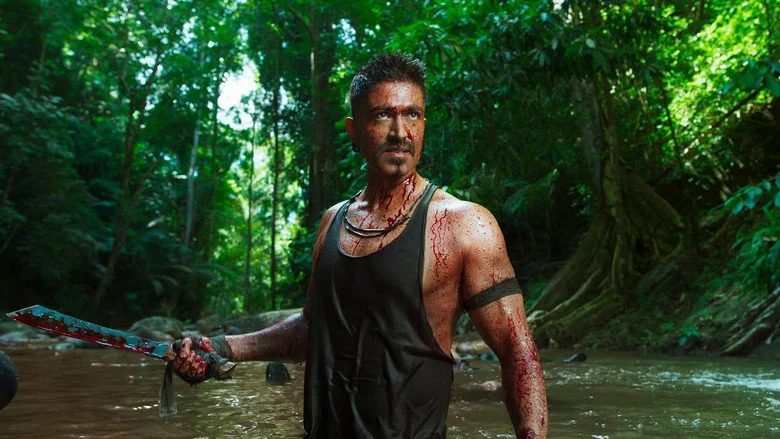
Yash doesn’t just headline Toxic, he splits himself in half. As Raya, the patriarchal gangster, and Rumi ‘Ticket’, the younger familial identity, he anchors the film’s entire conceptual gamble. The dual-role setup became a pre-release talking point for good reason: it forces one actor to carry both the crime arc and the emotional family drama simultaneously.
That’s a heavy load, and Yash handles the tonal shift with visible commitment. Raya’s confrontational authority and Rumi’s softer register create a productive tension that keeps the three-hour runtime from collapsing entirely. But the split also exposes how much of the film’s identity depends on a single performer’s range, a risk that doesn’t fully pay off when the script asks for more than physical presence.
Geetu Mohandas Directs Like an Auteur Trapped in a Blockbuster’s Body
There’s a real directorial voice here. Geetu Mohandas brings a period-political sensibility to the gangster framework, staging Goa as a sun-soaked arena where violence and betrayal share the same frame. Rajeev Ravi’s cinematography gives the coastal setting a tactile, lived-in texture that elevates even routine cartel confrontations.
But the screenplay lacks the same precision. The linear structure moves through family loyalties, romantic entanglements, and drug-trade politics without ever deciding which thread matters most. At 194 minutes, the film feels less like a tight crime drama and more like a director given too much leash and too many subplots to juggle.

The Gangster Genre: Where Toxic Finds Its Pulse
As a period gangster film, Toxic commits to its harder edges. The A certificate isn’t cosmetic, the violent and sexual content signals a genuine willingness to retain the uglier dimensions of crime-world storytelling. The Goa cartel premise, built around power, betrayal, and shifting loyalties, fits a genre that thrives on moral compromise. The adult rating allows the film to explore sexuality-and-power dynamics without the sanitizing cuts that often blunt mainstream Indian gangster films.
The action-thriller layer is where the film’s geography matters most. The period framing places criminal power inside a historical-political environment, which distinguishes it from a pure rise-to-power template like K.G.F. The factional conflict, supported by a large ensemble, creates a sense of a world larger than any single character. That’s a smart structural choice, the cartel feels like a system, not just a backdrop.
Yet the genre execution never reaches the visceral clarity of its best moments. The certification-driven violence is present, but the setpieces lack the spatial choreography that defines great action filmmaking. The confrontation between rival power structures in the climax lands with weight, but the path there meanders through family drama and romantic subplots that dilute the genre’s momentum. The dual-role structure supports both family and gang conflict, but the balance tips too often toward exposition over action.
For more on how Kannada cinema is pushing genre boundaries, browse our Kannada Action reviews.
Nayanthara, Kiara Advani, and Huma Qureshi: The Ensemble That Carries the Domestic Weight
Nayanthara, as Ganga, brings gravitas to the family-power axis. Her role as Raya’s elder sister grounds the emotional stakes, she represents the domestic cost of the gangster life, and her presence gives the crime narrative a human counterweight. It’s a performance built on restraint, and it works because she never overplays the suffering.
Kiara Advani’s Nadia reinforces the home-front dimension around Rumi/Ticket, adding a romantic thread that softens the film’s harder edges. Huma Qureshi’s Elizabeth, tied to Salvador and the antagonist network, embodies the sexuality-and-power dimension, her character feels like a deliberate provocation in a film unafraid of adult content. Akshay Oberoi’s Tony and Darrell D’Silva’s Salvador Almeida round out the factional conflict, with D’Silva giving the cartel a menacing, weathered authority.
The A-Certificate Politics and What Audiences Actually Got
Toxic courted controversy before release by leaning into its adult certification. The CBFC’s A rating and the reported 194-minute runtime became talking points, a film that refuses to trim its violence or sexual content for broader appeal. That’s a bold stance, but it also limits the audience: family viewers are locked out, and the long runtime demands patience even from committed genre fans.
The pre-release buzz centered on the cast lineup, Yash alongside Nayanthara, Kiara Advani, and Huma Qureshi, and the promise of a darker, more adult gangster tone. That promise is kept, but the lack of verified audience score data makes it hard to gauge whether the gamble landed. The film’s ambition is visible in every frame, yet ambition alone doesn’t justify three hours of screen time.
If Toxic’s sprawling narrative left you wanting more focused character work, Character s review digs into how a single performance can anchor a film’s identity with sharper precision.
For a film this long, the verdict comes down to patience. Go in for Yash’s dual performance and Rajeev Ravi’s visuals; stay if you’re willing to forgive a screenplay that loses its grip in the middle. Watch it on a regular theater or OTT, this isn’t an IMAX spectacle, and the intimacy of the family drama plays better on a smaller screen. Toxic is a film that respects its genre’s darkness but forgets that even gangster epics need a tighter edit.
Toxic (2026) earns a 2.5 out of 5, a visually striking, ambitious gangster drama that’s worth watching for Yash’s dual-role commitment, but its bloated runtime and unfocused screenplay keep it from greatness.
For a tighter take on a performance-driven narrative, Hushar Pittalu verdict shows how one actor can elevate a film even when the story wobbles.

Ankit Jaiswal is the Chief Author, covering Indian cinema and OTT releases with honest, no-filler criticism. An SEO strategist by background, he brings a research-driven approach to film writing, cutting through hype to tell you exactly what's worth your time.
Related Movies & Releases