Aroopi (2026): The Doll Breaks lands hard though the screenplay stays patchy

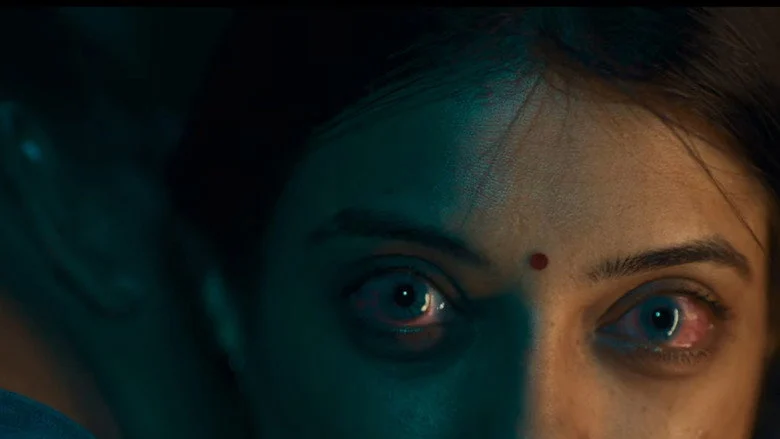
The thieves barely touch the seal, and the vintage doll on the Aryanattu estate splits open. A Yakshini, centuries of vengeful rage coiled into cloth and wood, slithers into frame with visual effects polished enough to justify the UA16+ certificate.
Vaisakh Ravi: A Debut Hero Who Understands Gravity
Niranjan is the last heir returning to a cursed lineage, a familiar beat in Malayalam horror. Vaisakh Ravi owns that return with a face that reads dread before the exposition arrives. His best moment comes during the brutal murder scene that pulls him back; he barely speaks, but his stillness suggests a man who already knows more than he admits.
This is a debut that signals instinct over training. I only wish the screenplay had given him a second gear beyond stoic resolve.
Abhilash Warrier’s Direction: Strong on Aesthetics, Weak on Rhythm
Warrier builds a handsome horror frame, the estate feels damp with secrets, and the doll’s emergence is shot with a restraint that makes the supernatural feel physical. But his screenplay follows a linear path that horror regulars will map before the interval. The middle section, where the curse claims one newcomer after another, settles into a loop of setup-scare-repeat that drains the initial tension.
The Yakshini and Her Containers: What the Supernatural Horror Actually Gets Right
The primary genre here is straight supernatural horror, and Warrier commits to the folklore without winking. The Yakshini’s visual design, particularly during her first scene emerging from the doll, leans on shadow, silk, and sudden movement rather than cheap jump scares. It respects the source material’s weight.
Where the film stumbles is in escalating that threat. After the doll breaks, the curse’s manifestations grow repetitive: a shadow here, a scream there. By the time Niranjan reaches his climactic confrontation in Act 3, the terror has plateaued into obligation.
The background score, while effective in isolation, is asked to carry too many scenes that the edit has left inert. The result is a horror film that looks good, sounds tense, but doesn’t trust its own silence.
For more films built on similar spectral foundations, browse our Malayalam Thriller reviews.
Supporting Cast: Neha Chawla Disappears, Everyone Else Fades In
Neha Chawla, Bollywood import, makes her presence felt entirely through physicality. As the Yakshini, she doesn’t have dialogue to hide behind, her eyes and the choreography of her wrath become the film’s most potent weapon. She transforms into the doll and out of it with a fluidity that suggests genuine craft investment.
Joy Mathew, as part of the thieves’ thread, brings the only trace of lived-in behaviour to the supporting ensemble. Sakshi Badala is handed a flat kit of “unsuspecting newcomer” traits and can only react, never shape. The rest of the cast, Sindhu Varma, Kiran Raj, Aditya Raj, register as bodies in a haunted house checklist rather than people whose fates matter.
Audience Reception and the One Risk That Might Pay Off
Early chatter after the July 3 release has trained its focus on two things: Vaisakh Ravi’s authenticity and the Yakshini’s design. The repetitive pacing complaints mirror the criticism of the middle act, but horror faithfuls are showing up for the visual craft. With no box office data yet, the film’s survival depends on whether word-of-mouth forgives the screenplay’s predictability for the sake of its atmosphere.
Aroopi is not a film for viewers who need their horror layered with psychological nuance or character arcs. It is a film for those who want a folk curse poured into a pretty frame, held together by a debut hero who understands the weight of silence. Watch it on a screen where the sound design can press against you, this is not a laptop experience.
If Aroopi’s folklore-horror discipline interests you, Abhilash Warrier’s risk-taking echoes the tonal gamble in Rao Bahadur review.
For a thriller that tightens its grip through a single set-piece, the Alpha verdict offers a masterclass in contained tension.

Ankit Jaiswal is the Chief Author, covering Indian cinema and OTT releases with honest, no-filler criticism. An SEO strategist by background, he brings a research-driven approach to film writing, cutting through hype to tell you exactly what's worth your time.
Related Movies & Releases